
The pump-to-signal conversion efficiency of the optical parametric amplifiers (OPA) is usually limited to about 20% and further amplification is accompanied by the degrading pulse and beam quality. Typically, the limiting factor here is the back-conversion process that (for Gaussian pulsed-beams) commonly starts at the full on-axis pump depletion. Back-conversion can be suppressed by eliminating the idler wave from the interaction before the pump wave is depleted. This was previously achieved by employing non-collinear pump recycling schemes [1] and idler absorbtion [2]. Nevertheless, when compared to the currently exploited standard solutions, these approaches tend to either consume a lot of space, demand exotic materials or lack tunability. In this work we propose and experimentally test a polarization-based idler elimination scheme for the suppression of the back-conversion in femtosecond OPA that is simple, compact, requires relatively inexpensive tools and preserves the wavelength tunability of the light source. This is achieved by using two consecutive crystals (see Fig. 1a.) cut for different nonlinear interaction types (type-I and type-II) in the same amplification stage. Idler wave, generated in the first crystal, cannot participate in the second interaction, because its polarization state is not supported by the nonlinear process. The enhanced idler amplification can also be achieved by rotating the type-II crystal for an interaction that satisfies the phase-matching conditions for o-polarized idler wave (see Fig. 1a.). We used a delay crystal in between the amplification crystals that compensates the temporal walk-off between pump and signal. This approach was tested by boosting the energy of the pre-amplified and temporally stretched white-light continuum.
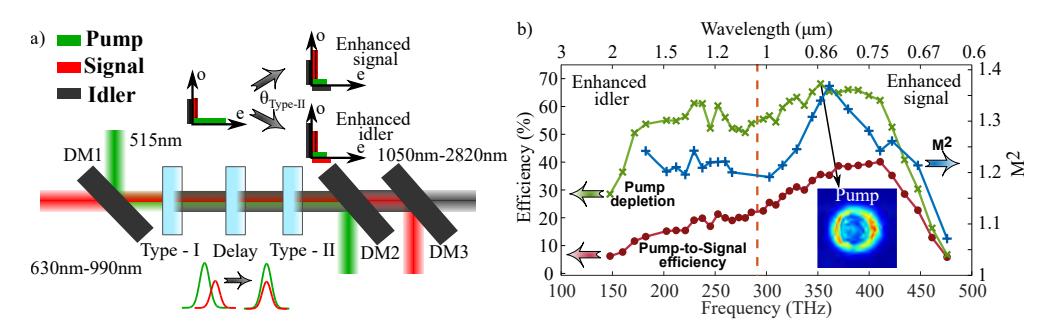
In our experiments beta barium borate ($\beta$ – Ba(BO2)2 - BBO) nonlinear crystals were employed. The main energy and output beam quality characteristics of the proposed booster amplifier are presented in Fig. 1b. Here pump-to-signal conversion efficiency, measured pump depletion after the DM2 and beam quality factor $M^2$ are plotted on the same frequency (wavelength) axis throughout the whole tuning range. The highest pump-to-signal energy conversion of 40% was obtained at 730 nm that corresponds to $M^2 = 1.25$. The maximal pump depletion value of 68% with corresponding $M^2 = 1.37$ was achieved at 850 nm. The rest of the $M^2$ curve qualitatively follows the pump depletion. The degree of the 68% pump depletion can be observed by looking at the output pump beam image after the last amplification crystal (inset of Fig. 1b.). Overall, Fig. 1b. favorably illustrates the capability to achieve pump-to-signal conversion efficiency of $\geq 30\%$ in the spectral range between 700 nm and 920 nm.
In conclusion, we have shown that the combination of type-I and type-II crystals enables one to achieve polarization-based idler elimination, which may greatly increase the conversion efficiency of short-pulse optical parametric amplification by suppressing the back-conversion process, and thus preserving the signal beam quality. In general, such two-crystal booster amplifier is cost-effective, has a broad tunability range and may serve as a convenient tool in many future nonlinear applications.