
The development of sociophysics brought significant attention to opinion dynamics. Recent years have seen new efforts to facilitate comparison of results from temporal opinion models to empirical or experimental data [1, 2]. Such data is usually rich in spatial diversity and accounting for mobility dynamics can bridge the gap of theory and experiment. However there is little investigation on effects of both temporal and spatial dynamics in spin models except for a special case of Ising model [3].
This research analyzes changes in spatial patterns of competing Metropolis (temporal) and Kawasaki (spatial) dynamics in Ising model. Numerical analysis is performed for competing dynamics model with various Metropolis temperatures TM and dynamics selection parameter p. Four distinct cases of Kawasaki dynamics temperatures TK are considered - zero (TK = 0), infinite (TK = $\infty$), critical (TK = TC) and varying temperatures (TK = TM).
Spatial patterns are determined by evaluating the proposed diversity index and calculating the fractal dimension by utilizing box-counting method. Both values are obtained through scaling of the model lattice. Diversity index is calculated by changing resolution of lattice just like with renormalization technique. Instead spins of the scaled lattice represent mean values of the spins from the original lattice. For each new scale of lattice relative standard deviation is calculated and a scaling curve is obtained. Usual antiferromagnetic, ferromagnetic and paramagnetic configurations result in unique scaling curves by this procedure and it is used to get diversity index values ranging from -1 (antiferromagnetic configuration) to 1 (ferromagnetic one).
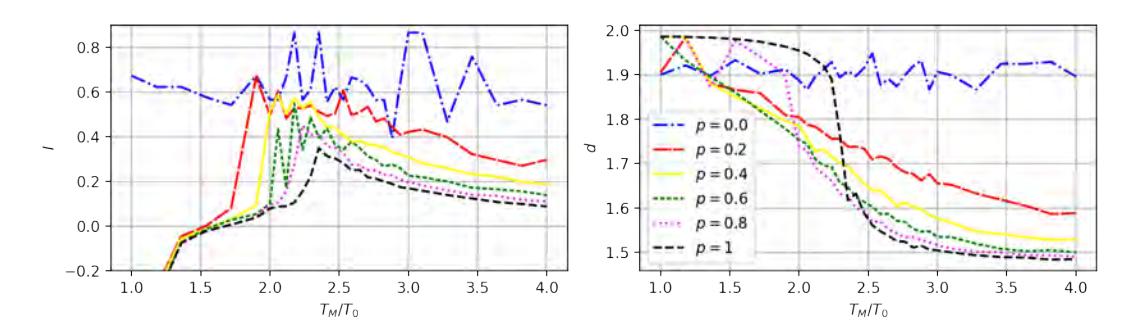
Two distinct cases of competing dynamics in ferromagnetic Ising model show profound changes in lattice configurations. Cases for zero and infinite Kawasaki temperatures leads to change of phase transition temperature. Zero temperature Kawasaki dynamics allows only energy reducing Monte Carlo steps and leads to formation of fractal structures in ferromagnetic temperature range as seen in Fig. 1. Whereas infinite temperature Kawasaki allows only energy increasing MC steps and antiferromagnetic ordering emerges for sufficiently small p.
Setting Kawasaki dynamics temperature equal to that of Metropolis results in Metropolis-type spatial patterns. Diversity index in such case reaches its peak value at critical temperature point even though ferromagnetic temperature range should show highest index values. This result is mainly due to inaccuracy of index with order parameter at limit values. Fractal dimension also differs from usual topological dimension at critical point confirming scale invariance. Paramagnetic temperature ranges exhibit non-integer fractal dimension due to the selected small boxes scaling range (see Fig. 1). Critical Kawasaki temperature case only strengthens domain separation at critical temperature value.
In conclusion, the non-trivial results of zero or infinite Kawasaki temperature in competing dynamics match those reviewed in [3] and referenced therein. In terms of spatial diversity, scaling methods prove relevant in capturing spatial patterns and scale invariances so abundant in Ising type models.