
Fossil fuel reserves decrease exponentially due to increasing energy demand. Hereby, as well as because of their negative impact on the environment, an important part of research in the area of electrochemistry is the development of environmentally acceptable sources of energy, such as fuel cells. Alkaline fuel cells (AFCs) convert chemical energy of a fuel into electrical energy in an eco-friendly and efficient way.
The oxygen reduction reaction (ORR) is the most common cathode reaction in fuel cells and thus it is essential for the operation and development of AFCs. The ORR as the cathodic reaction in alkaline media follows either a four-electron mechanism with water as product or the alternative two-electron mechanism with hydrogen peroxide as the product. Platinum group metals (PGMs) are key components in the production of most electrocatalysts used for electrocatalysis of the ORR [1]. However, although they are currently considered the best catalysts for the ORR [2], PGMs are extremely scarce and expensive, and therefore they prevent the full commercialization of fuel cells. Efforts have been made to develop alternative non-PGMs electrocatalysts based on transition metals, which have high catalytic activity, stability, and low cost.
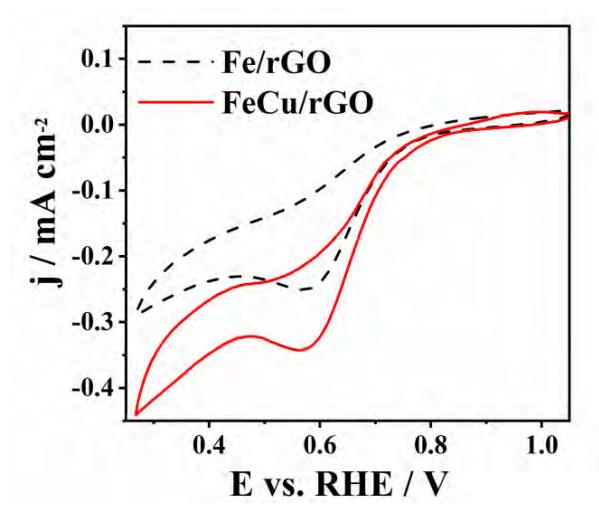
Herein, iron and iron-copper nanoparticles were deposited on reduced graphene oxide (Fe/rGO and FeCu/rGO), characterised by transmission electron microscopy (TEM) analysis, and examined as electrocatalysts for ORR in alkaline media. TEM images showed nanosized metal particles homogenously deposited on rGO. Subsequently, Fe/rGO and FeCu/rGO were examined in O2-saturaterd 0.1 M KOH solution (Fig. 1) by cyclic voltammetry. Characteristic ORR peak was obtained at 0.59 V for both Fe/rGO and FeCu/rGO electrocatalysts with current densities of -0.25 and -0.35 mA cm-2, respectively. These peaks clearly showed that both electrocatalysts are active for ORR with FeCu/rGO showing somewhat higher electrocatalytic activity under the same conditions. These nanostrucutred Fe/rGO and FeCu/rGO electrocatalysts could be a potentially good replacement for costly PGMs-based electrocatalysts for ORR because of their easy, fast, and low-cost synthesis.