
The giant algae Nitellopsis obtusa cells generate action potentials (APs) in response to mechanical stimulation, injury, or direct electrical stimulation. Each internodal segment is a single large cell, up to 10 cm and more in length suitable for biophysical research. The possibility of determining the excitation threshold and its alterations in N. obtusa cells allows linking the effect of many chemicals to the Ca2+-dependent initiation of excitation.
Inositol 1,4,5-trisphosphate (IP3) mobilizes Ca2+ from internal stores in animal cells during excitation. In plants an excitation-related IP3-induced release of Ca2+ from isolated vacuoles has been observed [1]. However, a direct link between an increase in the intracellular level of IP3 and the regulation of AP excitation threshold value is yet to be demonstrated.
We have used two-pair current clamp microelectrode technique to evaluate the AP excitation threshold (Eth). The cylinder-shaped N. obtusa internodal cell was placed in a chamber with electrically isolated compartments. APW (Artificial Pond Water) solution for control and 75 μM IP3 solution for exposure were used.
Results show that 30 min exposure to IP3 increases the excitability of Nitellopsis obtusa by hyperpolarizing the excitation threshold (Fig. 1). Spontaneous APs were also observed after the exposure to IP3.
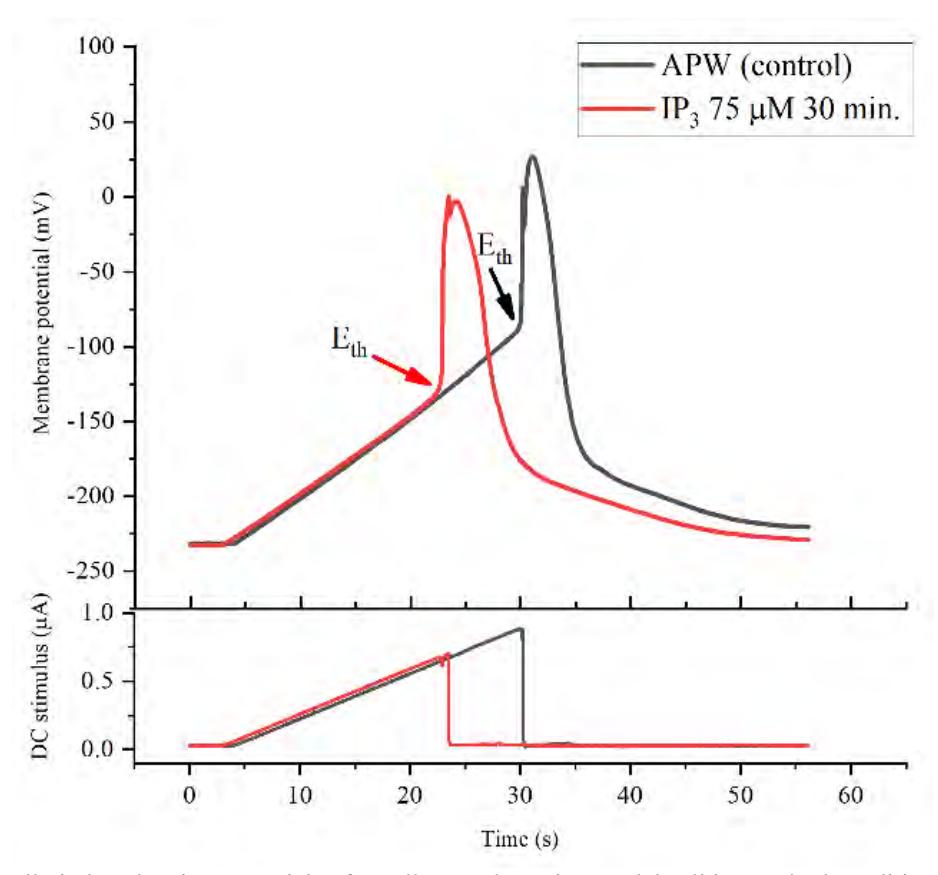
This investigation supports the proposition that IP3 increases the excitability of the single cell by releasing Ca2+ from internal stores. Further research should be done for the rest of the AP parameters.