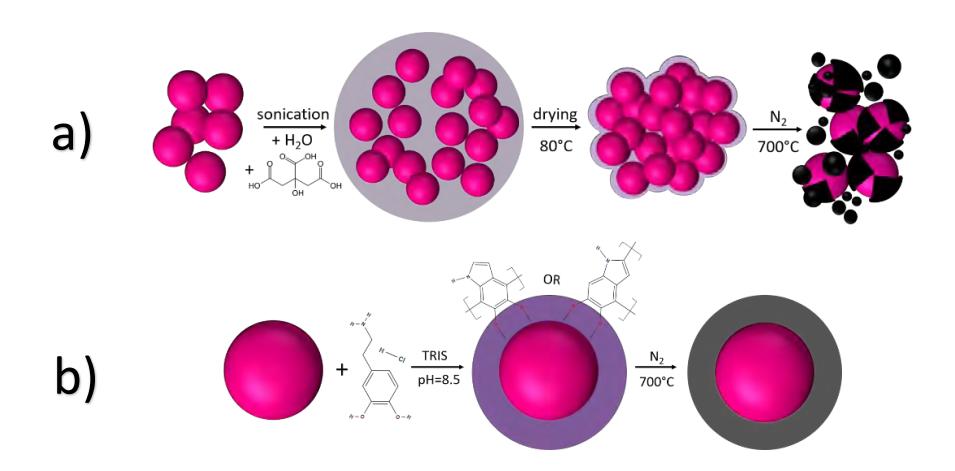
In the last decades, environmental awareness has induced the interest towards the development of novel renewable and clean energy storage devices. The market is currently dominated by lithium ion batteries, which, despite their obvious advantages, suffer from precursor's high cost and lack of environmental benignity. [1] As a result, sodium ion batteries, especially their aqueous modifications, have been pathing their way as an alternative to LIBs owing to sodium's high abundance in nature and elimination of highly toxic and flammable organic electrolytes. [2] NASICON-structured NaTi2(PO4)3 (NTP) is the most promising and studied aqueous Na-ion battery anode material owing to its high theoretical capacity, good thermal stability and environmental compatibility. Despite possessing a great ionic mobility, NTP suffers from inherently low electron conductivity. Moreover, active material dissolution and degradation into aqueous electrolyte results in inferior cycle life stability [4]. Conventional particle carbon coating by pyrolyzing glucose or citric acid does not ensure an even and controllable active material encapsulation. Growing a polymer e.g. polydopamine shell on the surface of active material is a promising route to obtain a controllable surface carbon layer, which is both protective and conductive [5].
The aim of this work was to investigate the dependency of electrode electrochemical performance on the precursor of carbon layer. The anode materials were prepared by varying the amount of citric acid and dopamine hydrochloride in the carbon-coating stage. The electrochemical properties of NTP electrodes were investigated by charge/discharge galvanostatic cycling and cycling voltammetry. The structural characterization was carried out via thermogravimetric analysis and Brunauer-Emmett-Teller (BET) surface area analysis.