
Crystallography allows to determine the exact positions of atoms that constitute crystal structures, [1] however, it is unable to capture chemical bonding. In practice, two atoms are considered to be connected by a covalent bond if the calculated distance between them does not exceed the sum of their covalent radii. Therefore, covalent radii tables, created by statistically analysing lengths of observed chemical bonds, are often used to determine chemical bonding.
The most popular covalent radii tables [2][3][4] are derived using data from the Cambridge Structural Database [5] which is distributed under a proprietary license and restricts the usage and spread of such derivative datasets. Thus there is a clear need to develop a completely independent workflow that allows covalent radii tables to be automatically calculated using open crystallographic datasets. In this research, methodology based on the determination of the van der Waals gap is used to determinate covalent radii in structures deposited to the Crystallography Open Database [6].
The van der Waals gap is an interval within the interatomic distance distribution that corresponds to the lowest density region [7] and separates peaks formed by covalent interactions from those formed mainly by van der Waals interactions. In order to identify the lowest density region, a Gaussian distribution mixture model is applied to the histogram of interatomic distances. Covalent radii are derived using the weighted least squares method.
The methodology used in this research is sensitive to structures with abnormal interatomic distance observations. To address this, suitable crystallographic structures were identified based on a set of quality criteria such as compatibility between the declared and calculated properties, use of standard experimental environment conditions, reasonable crystal structure density, etc. Currently applied filters determine about 70% of data structures published in the COD to be suitable for covalent radii derivation calculations. Further development and refinement of these criteria is part of an ongoing investigation.
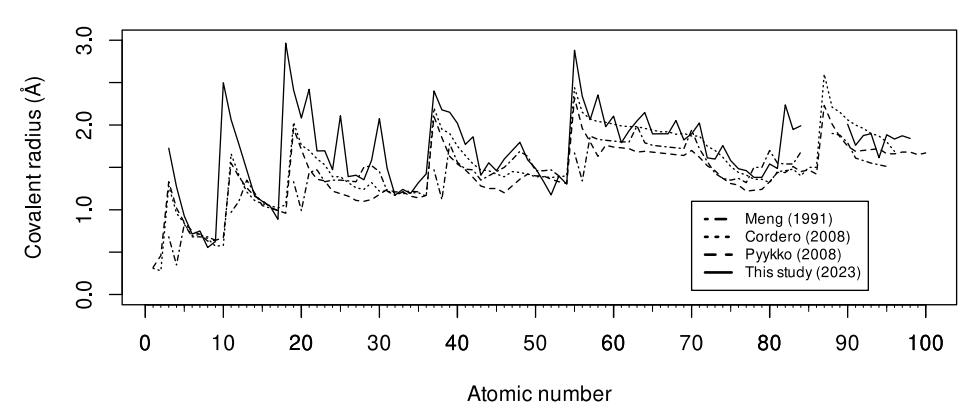
The comparison of derived results with selected published covalent radii tables is displayed in Figure 1. Review of the derived results, comparison between radii in published tables and visualisation of covalent bond length determination for pair of chemical elements are available online [8]. Furthermore, a tool for structure validation using derived covalent radii is accessible online [9].