
The global energy crisis leads to an increasing investigation of renewable and green energy sources. Pure energy can be produced by electrochemical water splitting where the main reactions are hydrogen evolution reaction (HER) as the cathodic reaction and oxygen evolution reaction (OER) as the anodic reaction. The main drawbacks of OER are high overpotential needed for the reaction to start and slow kinetics [1]. Benchmark OER electrocatalysts are iridium and ruthenium oxide (RuO2 and IrO2) but they are scarce, with a high price and low stability [1]. It is important to find an appropriate OER electrocatalyst that could be easily and inexpensively synthesized. Herein, synthesized iron and copper nanoparticles that are deposited on reduced graphene oxide (Fe/rGO and FeCu/rGO) are investigated for OER in alkaline media.
Scanning electron microscopy with energy dispersive X-ray spectroscopy (SEM-EDS) was used for the physicochemical characterization of Fe/rGO and FeCu/rGO electrocatalysts where the uniform disposition of metal nanoparticles onto reduced graphene oxide (rGO) is seen. The electrochemical testing of Fe/rGO and FeCu/rGO electrocatalysts for OER was done by linear voltammetry in 0.1 M KOH solution at a scan rate of 5 mV s-1.
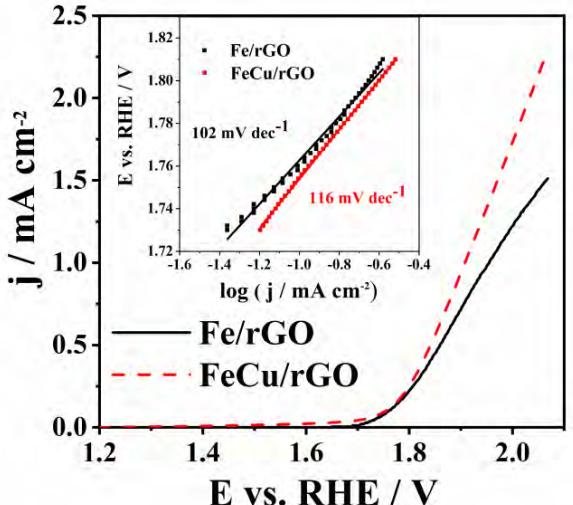
Polarisation curves of Fe/rGO and FeCu/rGO electrocatalysts under OER conditions were presented in Fig. 1. FeCu/rGO showed somewhat higher catalytic activity. The OER current densities were found to be 2.3 and 1.5 mA cm-2 at 2.1 V for FeCu/rGO and Fe/rGO electrocatalysts, respectively. Approximate values of Tafel slopes of 102 and 116 mV dec-1 were obtained for OER at Fe/rGO and FeCu/rGO electrocatalysts, respectively. Madakanu et al. obtained Tafel slopes with significantly higher values from 153 to 353 mV dec-1 for OER at iron oxide materials deposited on rGO [2]. Next, the stability of the prepared catalysts will be evaluated as another feature essential for use of a novel material in industrial water electrolysis cells.