Nitrobenzene (NB) is a common reagent in the industry. It is extensively used in the production of pesticides, dyes, explosives, polyurethane foams, elastomers, and industrial solvent production, and itiscontained in industrial waste, thus being air, water, and soil pollutant [1-3]. The contamination of water sources by NB could lead to severe health risks for humans. Due to its poor biodegradability, long-term residues, and accumulation in the environment, many countries have listed NB as a priority pollutant. Therefore, strategies for removing NB from aqueous solutions must be developed [4-5].
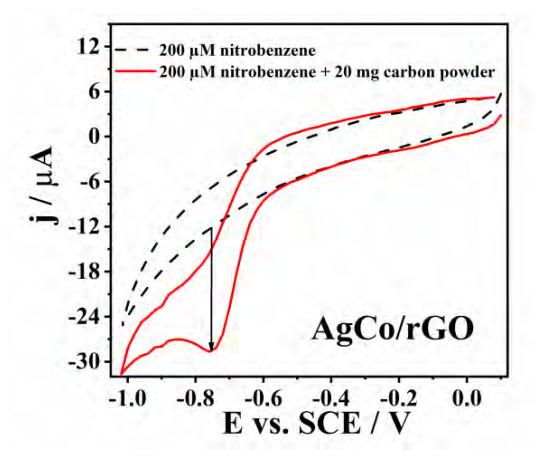
Fig. 1. Cyclic voltammograms of AgCo/rGO electrode in 200 μM nitrobenzene + phosphate buffer without (-) and after mixing with 20 mg of carbon powder (---).
The NB adsorption on the carbon obtained from coconut shells was studied at pH 7. Carbon powder (20 mg) was placed in 50 mL of 200μM NB solution andmixed for 10 min. The sample was next filtered. Figure 1. shows that the control cyclic voltammogram of AgCo/rGO electrode recorded in solution after treatment with carbon powder doesnot show peaks in the potential range where the NB reduction reaction is expected, while the cyclic voltammogram recorded in 200 μM NB, before treatment, shows a reduction peak of NB at a potential of about - 0.78 V. Result shows that carbon powder obtained from coconut shells can be usedfor succesful adsorption of NB from aqueous solution.
Acknowledgments: The authors would like to thank the Ministry of Education, Science and Technological Development of theRepublic of Serbia (contract no. 451-03-68/2022-14/200288, 451-03-68/2022-14/200146 and 451-03-68/2022-14/200168).Fundação para a Ciência e a Tecnologia (FCT, Portugal) is acknowledged for contract no. IST-ID/156-2018 (B. Šljukić).
[1] W.Wei, R. Sun, Z.Jin et al., Hydroxyapatite–Gelatin Nanocomposite as a Novel Adsorbent for Nitrobenzene Removal from Aqueous Solution. Appl. Surf. Sci. 292, 1020–1029 (2014).
[2] Y.Mu, R. A.Rozendal, K. Rabaey, et al., Nitrobenzene Removal in Bioelectrochemical Systems. Environ. Sci. Technol., 43 (22), 8690–8695 (2009).
[3] S.-S.Li, J.-H.Fang, L. Li, et al., An Ultra-Sensitive Electrochemical Sensor of Ni/Fe-LDH toward Nitrobenzene with the Assistance of Surface Functionalization Engineering. Talanta225, 122087 (2021).
[4] D. Wang, H. Shan, X. Sun, et al., Removal of nitrobenzene from aqueous solution by adsorption onto carbonized sugarcane bagasse. Adsorption Science & Technology. 36(5-6):1366-1385 (2018).
[5] H. Gu, Y. Gao, M.Xiong, et al., Removal of nitrobenzene from aqueous solution by graphene/biochar supported nanoscale zero-valent-iron: Reduction enhancement behavior and mechanism, Separation and Purification Technology275, 119146 (2021).