
Carbon nanoparticles have garnered a notable amount of attention from the scientific community for their properties, such as excellent electric and thermal conductivity, mechanical stability and the possibility to develop structures that either reflect or transmit light incredibly effectively [1]. Effective practical applications of carbon nanoparticles generally necessitate the formation of various hybrid materials, which stabilises the nanoparticles and enables their use on meso- and macro- levels [2]. One such category of hybrid materials is carbon nanoparticle composites, consisting of carbon nanoparticles distributed in a polymer matrix [3]. These composites are considered to be disordered materials, and their electric properties are dependent on their structure and carbon nanoparticle filler concentration. Therefore, such materials warrant investigation to identify considerations for potential applications.
Low-frequency noise measurements are an effective method for investigation of conduction mechanisms in disordered materials. Of particular note is low-frequency noise that exhibits a spectral density which is inversely proportional to the frequency, also known as 1/$f$ noise, the level of which determines the sensitivity limits of sensors [4].
The resistivity and low-frequency noise characteristics of hybrid composites with carbon nanotubes (CNT) and graphene (GR) were investigated. Samples were prepared via melt processing of the polymer Peran STC and different concentrations of CNT and GR. Measurements of resistance and low-frequency (10 Hz – 20 kHz) noise characteristics were carried out in a temperature range of (75–365) K. Dominant conduction mechanisms and their dependence on the filler densities were investigated.
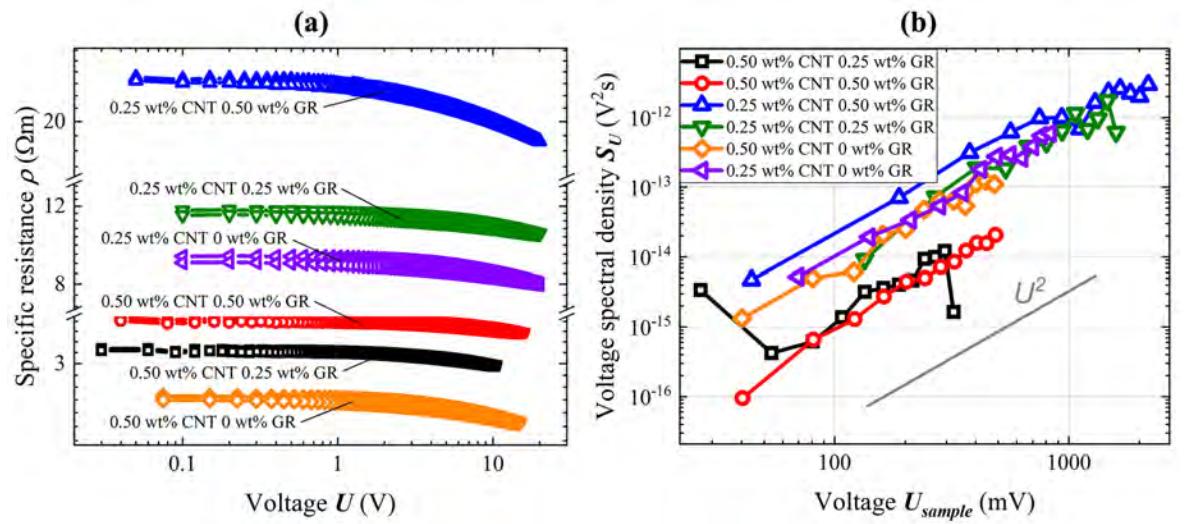
The specific resistance of the CNT and GR composites depends more strongly on the concentration of CNT (Fig. 1(a)). In samples with identical CNT concentrations, the samples with lower GR content exhibit lower specific resistance. At temperatures above 323 K, the specific resistance of the composites irreversibly decreases due to the decrease of the specific resistance of the polymer matrix.
At low temperatures ((75–245) K), the temperature dependence of specific resistance is well-fitted by Mott's law, and the dominant charge transfer mechanism in this temperature region is said to be Mott's variable-range hopping.
The resultant low-frequency voltage noise spectra of the investigated carbon nanocomposites consists of 1/$f^{\alpha}$ type noise and impulse noise. The low-frequency voltage noise spectra is proportional to the voltage square $U^{2}$ (Fig. 1(b)), and the intensity of the noise is proportional to the specific resistance of the composite.