
Laser-induced Graphene (LIG) is a simple method of interacting with the material to produce flexible components for energy storage devices, supercapacitors, water-splitting electrocatalysts, piezoelectric strain gauges, electrochemical biosensors, photodetectors, sensors etc. Furthermore, this process enables the production of a novel conducting polymer with less difficulty in integrating it with an electrode, which is highly helpful in flat or flexible systems.
In order to further extend the capabilities of LIG, the process combined selective laser pyrolysis and carbonisation on polyimide (Pl) to produce graphene, which has better capabilities in the technical aspect of several standard used materials or used as an enhancing property for a prototype of electrochemical sensor.
The LIG was formed on the surface of the Pl film using Atlantic picosecond laser (Ekspla). The laser pulse duration was 10 ps, the pulse repetition rate was 100 kHz, and the irradiation wavelengths were 355, 532 and 1064 nm. The beam and laser power were controlled to extract different scanning speeds, scan repetitions, focus, and powers. The PI film was placed at different focus ranges to obtain the lowest resistance (Ω) or sheet resistance (Ω/sq) on the film in a rectangular structure (1x1 or 1x2 cm).
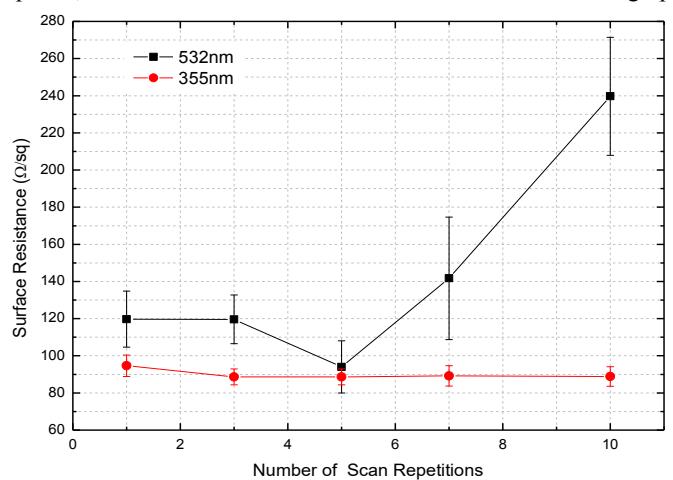
Resistivity testing of the LIG products was carried out using a simple voltmeter and the 4-probe method. The products were first fabricated using different parameters, and then it was decided which parameters to use to select the best resistance results. The lowest achieved resistances can be seen in the figure 1 (made using parameters from table 1), these samples for prototypes do not crumble, and no additional damage is visible. At 355 nm, the surface resistance error is seen to be ~10 Ω/sq while at 532 nm it is in the range of ~20-60 Ω/sq. The structure of the LIG was investigated using Raman spectroscopy and showed that the spectra of the 355 nm and 532 nm samples exhibit pronounced peaks characteristic of multilayer graphene, and the structure of 532 nm was found to be closer to graphene than at 355 nm.
| Sample | LIG532 | LIG355 |
|---|---|---|
| Wavelength | 532 nm | 355 nm |
| Irradiation power | 500 mW | 200 mW |
| Scanning speed | 50 mm/s | 10 mm/s |
| Scan repetitions | 5 | 5 |
| Hatch | 10 μm | 10 μm |
| Position regarding focus | At the focus | 4mm from the focus |
Using picosecond laser irradiation, a multilayer graphene structure on a PI material has been successfully obtained using two different laser wavelengths (532 nm, 355 nm). Both types of samples were used to prototype pH sensors and were found to be suitable for pH sensor electrodes. The main advantages over other polymer-based pH sensors are that they have a shorter accumulation time (600 s), the sensor is reproducible, selective and stable for up to 70 days.