Photoelectrochemical (PEC) decomposition of organic compounds is attracting great attention from scientists and industry, because it enables to decompose various hazardous organic compounds to more environmentally friendly products. PEC system has many advantages, e.g. sustainability, because it uses sunlight energy, and flexibility - many types of organic compounds can be decomposed, moreover, this process can be coupled with production of hydrogen [1]. PEC decomposition is based on oxidation of organic compounds on the surface of photoanode under light illumination. The most widely studied photocatalysts are TiO2, ZnO, WO3, BiVO4 and Fe2O3 [2]. Bismuth vanadate (BiVO4) is a promising material, because of its ability to absorb visible light, low valence band position (2.4 V) and stability in neutral electrolytes.
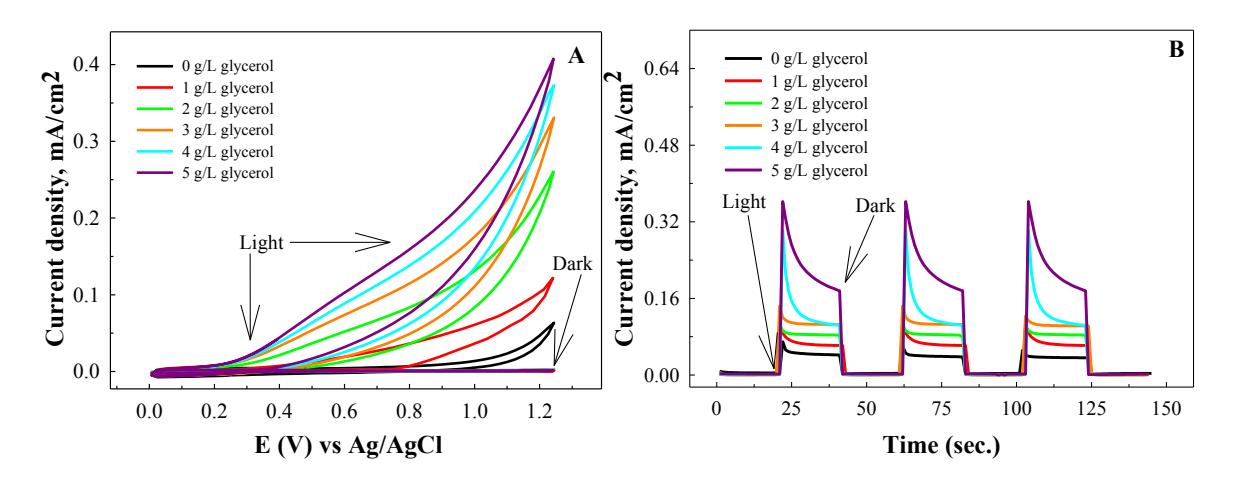
In this work bismuth vanadate was used for PEC decomposition of glycerol. BiVO4 thin films were synthesized using sol-gel route and dip-coating technique. Composition and morphology of electrodes were studied using X-ray diffraction and scanning electron microscopy, respectively. Photoresponse of BiVO4 photoanode was first evaluated using cyclic voltammetry (CV) in 0.5 M Na2SO4 and 0.5 M NaCl electrolytes. Electrochemical impedance spectroscopy (EIS) measurements were performed to evaluation of charge transfer resistance of the films. Next, CV and chronoamperometric (CA) experiments were performed in 0.1 M NaCl solution with 1, 2, 3, 4 and 5 g/L of glycerol under illumination. Certain amount of charge was passed through the cell in CA experiments. After that the amount of glycerol was evaluated using Fourier-transform infrared spectroscopy (FTIR). Results of CV and CA experiments are presented in Fig. 1. It can be seen that photocurrent density was increasing with increase in concentration of glycerol. The efficiency of glycerol decomposition will be discussed at the conference.