Near infrared (NIR) range is important since it covers laser applications in medicine [1], sensing [2], telecommunications [3] etc. Today, different applications require different laser parameters. Preference is given to lasers that are compatible with other components, not only in terms of dimensions, but also in terms of power, beam geometry, wavelength stability etc. Optical properties of InGaAs quantum well (QW) structures are intensively studied, and it is shown they are suitable for gain media in NIR lasers [4]. However, the growth of InGaAs multiple-quantum wells (MQW) lasers with desired specifications still requires precise optimization in order to find propre growth conditions and design of quantum structure to achieve specific optical properties.
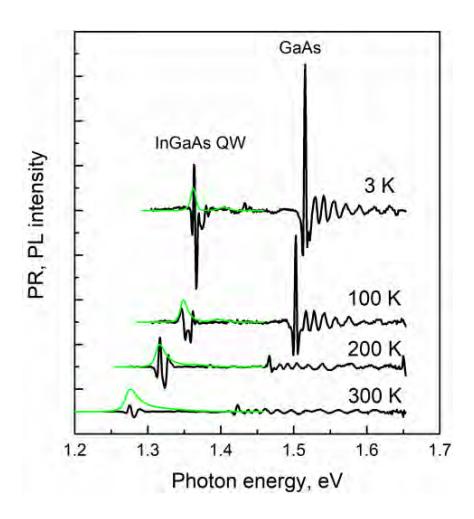
Comprehensive optical study of molecular beam epitaxy grown InGaAs multiple-quantum wells is presented in this work. All investigated structures consisted of twelve InGaAs/GaAs QW. The indium content within QW layer together with thickness of QW were varied in order to obtain emission wavelength at 976 nm. Temperature-dependent photoluminescence (PL) and photoreflectance (PR) spectroscopy techniques were used to probe interband optical transitions over the temperature range of 3 - 300 K (see Fig. 1). PL and PR features positions versus temperature were analysed using Varshni equation [5]. Moreover, activation energies evaluated from PL measurements provided in-sight into thermal quenching processes of luminescence. Finally, numerical calculations were performed using nextnano software [6] to interpret the observed optical features.
Fig. 1. Temperature-dependent PR and PL spectra of In0.22Ga0.78As/GaAs MQW structure.
Acknowledgments: This research was supported by Research Council of Lithuania under grant No. S-MIP-22-86 (LMTLT) "A3B5 Nanostructure-Based Near Infrared Lasers".
[1] V. V. Tuchin, E. A. Genina, A. N. Bashkatov, G. V. Simonenko, O. D., Odoevskaya, G. B. Altshuler, A pilot study of ICG laser therapy of acne vulgaris: photodynamic and photothermolysis treatment, Lasers in Surgery and Medicine: The Official Journal of the American Society for Laser Medicine and Surgery, 33(5), 296-310 (2003).
[2] P. A. Martin, Near-infrared diode laser spectroscopy in chemical process and environmental air monitoring, Chemical Society Reviews31(4), 201-210 (2002).
[3] H. Nasim, J. Yasir, Diode lasers: From laboratory to industry, Optics & Laser Technology56, 211-222 (2014).
[4] N. Tansu, J. Y. Yeh, L. J. Mawst, Extremely low threshold-current-density InGaAs quantum-well lasers with emission wavelength of 1215–1233 nm, Applied Physics Letters82(23), 4038-4040 (2003).
[5] Y. P. Varshni, Temperature dependence of the energy gap in semiconductors, Physica34(1), 149-154 (1967).
[6] See http://www.nextnano.de/nextnano3 for nextnano3, next generation 3D nanodevice simulator.