
Dyes are essential chemicals needed in the textile, tanning and printing industries. However, the treatment of dye effluents has been problematic, making it a leading contaminant in wastewater. Many solutions are being proposed and studied for the remediation of dyes, including filtration, ion exchange, coagulation, biological treatment, adsorption and photocatalyst. Adsorption via nanomaterials has been extensively explored for dye removal; however, they still have some drawbacks. The difficulty of collecting them after the adsorption process is notable due to their size.
In this work, the sacrificial template technique was used to prepare a polymer clay nanocomposite to understand the adsorption mechanism of methylene blue dye onto the fabricated composite. The composite was prepared from polydimethylsiloxane (PDMS), nano clay particles(< 50 nm) and magnetite nanoparticles. The PDMS and nano clay were obtained from Sigma Aldrich, whereas the magnetite nanoparticles were synthesised using a green approach. Three samples were used for this study: a control sample with only PDMS; a sample with PDMS and nanoclay (called PB); and a sample with PDMS, nano clay and magnetite nanoparticles (called PBNP). The adsorption test was run by preparing a standard methylene blue dye solution at a concentration of 5 mg/L to mimic the contaminant and expose the adsorbent to it for 5 hours. At the end of the period, the data collected was modelled using the pseudo-first-order, pseudo-second-order, intra-particle diffusion and Boyd kinetic models to understand the kinetics of the process adsorption process. The isothermal behaviour was understood by the Elovich, Harkins-Jura and Dubinin-Radushkevich models.
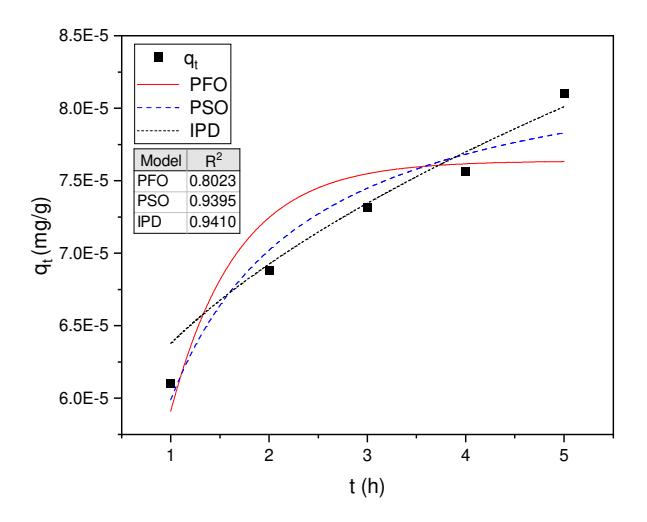
The findings of the study revealed that homogenus dispersion of the nano phase was achieved in the polymer matrix. However, the heterogenity of the adsorbent's surface influenced the adsorption process. The result from the isothermal modelling revealed the adsorption process for PB and PBNP both fit the Elovich. This is evidence of multilayer formation on the adsorbents surface influenced by chemical reaction. The exponential increase adsorption postulated in this model can be attributed to the varying surface energies caused by the heterogenity. The kinetic models also go to suppport his chemical adsorption process with PBNP fit both pseudo second order model and intra-particle diffusion model This points to multi process adsorption as a result of presence of the magnetite and clay nanoparticles and causing surface heterogenities. The data from the PB sample indicated that the kinetic process indicated a process governed by intra-particle diffusion.
It is seen that the adsorption of methylene blue dye unto the surface of the polymer clay nanocomposite involves varied interactions due to the complexity of the material's surface.