
Fluctuating fuel prices, climate change, soil and ecosystem degradation, and growing world population are motivating the researchers to explore new technologies that lessen the society's dependance on the ecological capacity of Earth. Lignocellulosic biomass is recognized as one of the largest sources of sustainable and renewable organic material on Earth that could be used to produce fuels and bio-based products [1]. Effective fractionation of biomass into its main components (cellulose, hemicellulose and lignin) is essential in order to achieve efficient utilization of lignocellulosic materials. Pre-treatment is considered to be the most important step for obtaining an efficient conversion of biomass into value-added products; nevertheless, it is also one of the most expensive steps in a biorefinery process [2].
Deep eutectic solvents (DES) are a mixture of two or more compounds with a significantly lower melting point compared to the starting materials. DES are made by combining an appropriate hydrogen bond acceptors (HBA) and hydrogen bond donors (HBD) in specific molar ratios (Fig. 1.).
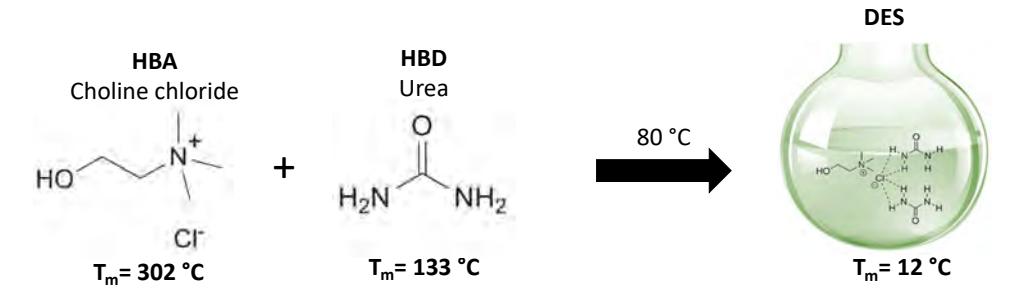
DES have attracted the attention of the scientific community due to their ability to process and selectively dissolve biomass components to yield polysaccharides and lignin [3]. DES have many advantages over organic solvents commonly used in chemical and biochemical processes: negligible vapor pressure, non-flammability, high chemical and thermal stability, low toxicity, biodegradability, recyclability, and low price, among others [4]. DES have been recognized as a promising solvent for biomass pre-treatment, although DES applications toward biomass are still in its nascent stage.
In this project, we explored synthesis of four different choline chloride-based DES using urea, lactic acid, citric acid and linoleic acid as HBD. To confirm formation of DES, we used attenuated total reflectance – Fourier transform infrared spectroscopy. Furthermore, we studied DES properties and application in lignocellulose (wheat straw) processing.