
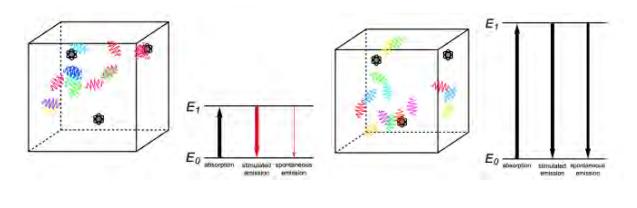
The quantum theory of radiation pictures atoms with quantized energy levels interacting with an assembly of photons of varying frequencies $\omega$. When the energy difference between two atomic states fulfills a resonance condition $\hbar\omega = E_1-E_0$, three possible transition processes can occur: absorption, stimulated emission, and spontaneous emission. In the electric-dipole approximation, the transition rates for absorption and stimulated emission are given by [1]:
$$W_{abs} = W_{stim\ em} = \frac{4\pi^2}{3 \hbar^2} \rho(\omega) |\langle 0|\mu|1\rangle|^2$$where $\mu$ is the electric dipole operator and $\rho(\omega)$ is the spectral density of the radiation field at frequency $\omega$. The corresponding rate of spontaneous emission is:
$$W_{spont\ em} = \frac{4\omega^2}{3 \hbar c^3} |\langle 0|\mu|1\rangle|^2$$All three radiative processes depend on the matrix element $\langle 0|\mu|1\rangle$ and therefore obey the same selection rules. A convenient measure of the intensity of a transition is the oscillator strength:
$$f_{0,1} = \frac{2m_e \omega}{3 \hbar e} |\langle 0|\mu|1\rangle|^2$$makes spontaneous emission significant only for higher-energy transitions—in practice, only for optical frequencies and higher. The Figure 1 shows the transition-energy range of 0.1 to 10 eV, corresponding to radiation wavelengths of 12000 to 120 nm, which includes the visible region 380–750 nm, as well as parts of the infrared and ultraviolet (fig. 1).
At normal temperatures, only the $\nu = 0$ vibrational level of the ground state is occupied. When a molecule absorbs a photon in an electronic transition, the electrons can rearrange themselves much more rapidly than the much heavier nuclei (consistent with the Born-Oppenheimer approximation). Thus, electronic transition can be approximated by the vertical blue arrow to internuclear distances R in the excited state very close to its maximum value in the ground state. This leads to a mixture of several excited-state vibrational levels, predominated by the level that completely overlaps with the $U_0^{(0)}$ wavefunction. According to the Franck–Condon principle, the relative intensities of the individual vibrational peaks are proportional to the factors $|\langle U_{\nu_2}^{(1)} U_0^{(0)} \rangle|^2$. This gives rise to an absorption spectrum shown in blue. The relative intensity of the vibrational components depends on the molecular parameters of the two electronic states, but most sensitively on the difference between equilibrium internuclear distances, $R_0$ and $R_1$.
A molecule excited in an electronically allowed transition will generally return to its ground electronic state, a process called fluorescence, within the order of a few nanoseconds. Before it does so, most of the excited molecules will decay to the lowest vibrational state $U_0^{(1)}$ by radiationless transition processes, such as internal collisional processes between molecules. These are represented in the upper curve by a series of black arrows. Fluorescence will then produce a series of peaks corresponding to different vibrational levels of the ground state, with intensities proportional to the Franck-Condon factors $|\langle U_{\nu_1}^{(0)}U_0^{(1)}\rangle|^2$. Because of the geometry of the energy curves, the fluorescent spectrum is very nearly a mirror image of the absorption spectrum, with the transitions $\nu_1 = 0 \leftrightarrow \nu_2 = 0$, meaning that this same transition occurs in both the absorption and fluorescence spectra [2].