Fano resonance is observed as a closely spaced peak and dip in metasurface transmission or reflection spectra. The excitation of Fano resonance is caused by interference between two resonances of narrow (discrete) and broad (continuum) line shape. The two resonances can be excited due to different physical reasons which determine the nature of Fano resonance. It is observed that interference of resonances such as plasmonic, waveguide and Fabry-Perot can lead to excitation of Fano resonance [1,2]. The issue is that often it is unclear which conditions have to be satisfied for the excitation of Fano resonance. A better understanding of all the necessary conditions would improve the current understanding of Fano resonance in metamaterials and could lead to invention of new devices.
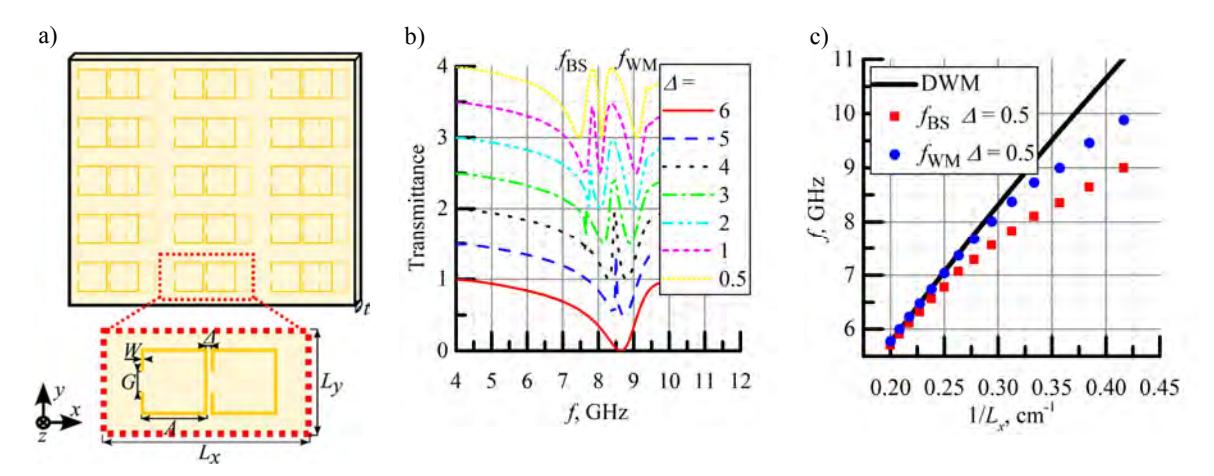
It has been experimentally shown [3] that a metasurface composed of shifted split-ring resonators (SRRs) exhibits multiple Fano resonances, which are excited due to the broken symmetry of the structure. This is achieved by displacing every second column of the SRRs from the symmetry position as is shown in Fig. 1 a). Even a small change of distance Δ between the adjacent SRR causes the appearance of a strong Fano resonance (fWM) (ref. to Fig. 1 b)). The second Fano resonance (fBS) appears when the columns of SRRs are sufficiently close to each other, and becomes progressively stronger with decreasing Δ. Such behavior suggests that the nature of the two Fano resonances is different. It is theorized that the waveguide mode is required for excitation of both resonances. However, the first resonance (fWM) arises purely due to the interference of the waveguide mode (discrete) with plasmonic resonance (continuum), while for the excitation of the second resonance (fBS) the waveguide mode is a necessary but not sufficient condition. The distinction is illustrated in Fig. 1 b), which shows that at large waveguide period (Lx), the frequencies of both Fano resonances coincide with the dielectric waveguide mode (DWM) characteristic frequency, arising in the metasurface due to the diffraction of electromagnetic wave on the periodic structure. As the waveguide period decreases, the frequencies of both Fano resonances diverge, indicating that the approach of the shifted resonator columns to each other affects the frequencies of the Fano resonances differently (ref. to Fig. 1 c)). It should be noted that both frequencies diverge from the DWM line but fBS diverges faster. To elucidate the details of the observed phenomenon, we investigate distributions of electric fields and currents flowing in the SRRs.