
Silicon is one of the most widely used semiconductors in micro- and nano-electronics applications. Silicon based particle sensors are widely employed in high energy and nuclear physics experiments for registering of ionizing radiation. One of the most prominent examples is the Large Hadron Collider (LHC) at CERN, where silicon based sensors are employed for particle tracking applications. However, high-energy radiation creates electrically active defects within the bandgap of the material, which determine the deterioration of sensor functional characteristics, e.g., increase of leakage current, decrease of charge collection efficiency, etc. [1]. On the other hand, measurements and analysis of changes of sensor functional characteristics can find beneficial applications, such as dosimetry [2]. Therefore, it is important to characterise the devices before and after irradiation in order to predict the variations of sensor parameters under impact of ionizing radiation, to determine the radiation hardness, to develop new structures and to search for alternative applications.
In this work, a set of Si sensors of CERN standard, irradiated by penetrative protons with fluences in the range of $\Phi$ = 1012-1016 p/cm2 were investigated. Current-voltage (I-V) and capacitance-voltage (C-V) characteristics were measured and analysed.
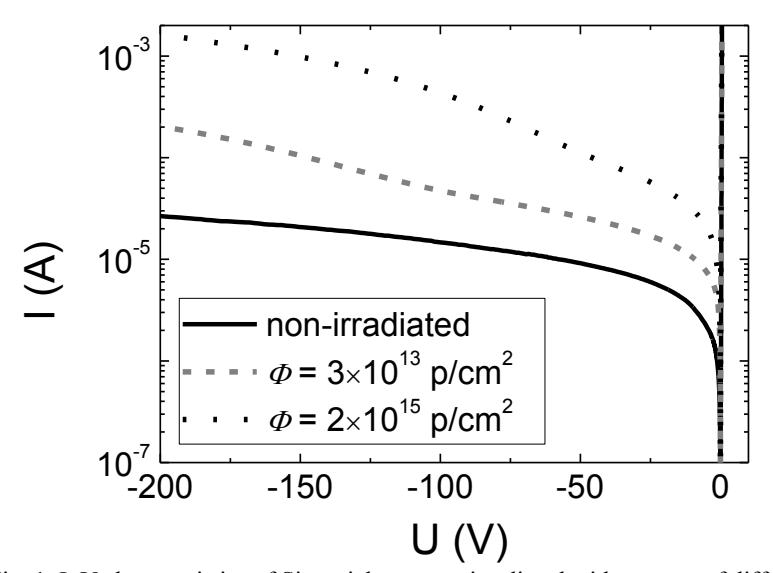
It was found that leakage current (Fig. 1) in sensors increases with irradiation fluence. This phenomenon can be explained by increased density of radiation defects, which act as generation centres. Analysis of C-V characteristics showed variations of effective dopants density in irradiated samples. However, C-V technique could not be applied in heavily irradiated samples due to increased leakage currents. The variations of electrical characteristics and their correlations with proton fluences will be presented and discussed.