
Nowadays mankind is in need of green energy sources. Photocatalytic processes could help us to get energy in ecologically-friendly ways (for example, photosynthesis is photocatalytic process). Moreover, photocatalytic processes not only involve chemical reactions between the molecules being in the ground state, but also depend on their electronic excited states. That is the reason of studying charge separation processes in complex systems, such as photosynthetic complexes. But for the beginning simpler systems are worth studying.
In this work two different dimeric Porphyrin systems are studied, namely TPP-Ur-TPP (P2Ur) and TPP-Ur-F6 (P2UaS), both solubilized in either DCM or DMSO. The difference between them is that P2Ur (Fig. 1a) has symmetrical structure of the molecule and P2UaS has an asymmetrical structure. In order to characterize the excited states of these molecules and also to study the formation of intra-molecular charge transfer states, we performed a set of the stationary and time-resolved spectroscopic measurements: transmission, fluorescence, and transient absorption (TA). The later are shown in Fig. 1b and c.
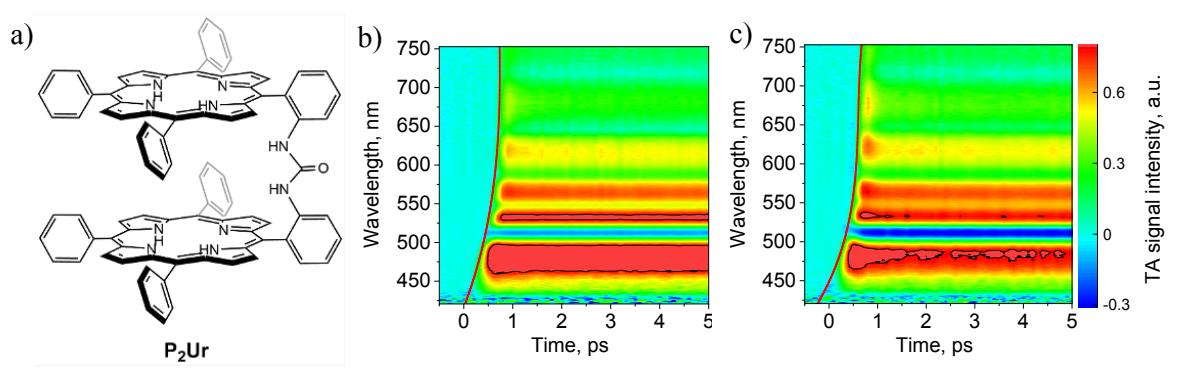
TA spectra in combination with global analysis techniques provide detailed information about the ultrafast transitions between electronic states of the studied molecules. More details about the samples as well as the obtained spectral characteristics of their excited states and the light-induced excitation dynamics will be presented at the conference.