
In recent years, much interest has been focused on the fabrication of heterojunctions capable of providing improved photocatalytic activity, in particular for p- and n-type semiconductors, which form a junction with a space charge region at their interfaces. [1].
Our aim was to synthesize environmentally friendly spinel-type mixed Zn-Co coatings with a double p-n heterostructure, to investigate the photoelectrochemical properties and to test them as promising materials for catalyzing the oxygen evolution reaction (OER).
Mixed Zn-Co oxide layers (Zn:Co 1:1,25) were formed by a two-step synthesis: chemical precipitation and heat treatment (400-600 °C). First, solutions of 0,5 M cobalt nitrate and 0,5 M zinc nitrate were mixed by the slow addition of 200 ml of 1 M NaOH with continuous stirring (Figure 1). The precipitates were heated at 400-600 °C for 2 hours in an air atmosphere.
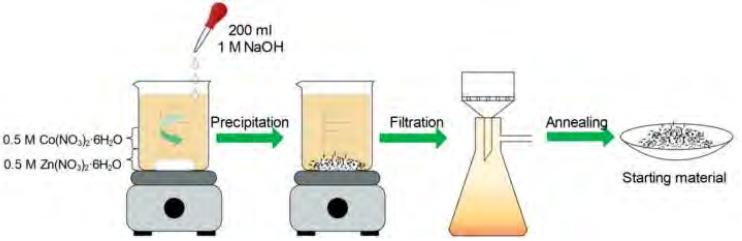
The photoelectrochemical activity of the prepared mixed Zn-Co oxide layers was investigated in a quartz cell in phosphate-buffered saline (pH 7), using a General Electric F8W/BLB lamp with $\lambda_{\text{max}}$=366 nm and an average power density of 1,8 mW cm-2 as a UV source. The UV source was located at a distance of 2 cm from the working electrode. The IPCE value of the photoelectrode was calculated using the following equation [3].
$$IPCE(\%) = 100 \frac{1240 j_{\text{ph}}}{\lambda P}\tag{1}$$Where $j_{\text{ph}}$ is the photocurrent density in mA cm-2, $\lambda$ is the wavelength of the incident light in nanometres (in this case 366 nm), P is the intensity of the incident light in mW cm-2.
In order to characterise the photoresponse efficiency of the photoelectrode material at the applied voltage, the photon-current efficiency (ABPE) calculations were carried out according to the following equation [2]:
$$ABPE(\%) = 100 \frac{|j_{\rm ph}| \cdot (1.23 - |V_{\rm appl}|)}{I_0}\tag{2}$$Here $j_{\text{ph}}$ is the photocurrent density (mA cm-2), I0 is the input intensity of the light incident on the surface of the photoelectrode (1,8 mW cm-2), and Vapp is the applied potential, which is calculated according to equation [1]:
$$[1]: V_{\text{appl}}=V_{\text{mea}} - V_{\text{oc}}\tag{3}$$Here $V_{\text{mea}}$ is the potential of the working electrode at which the photocurrent was measured under illumination and $V_{\text{oc}}$ is the potential of the working electrode in an open circuit under similar conditions.