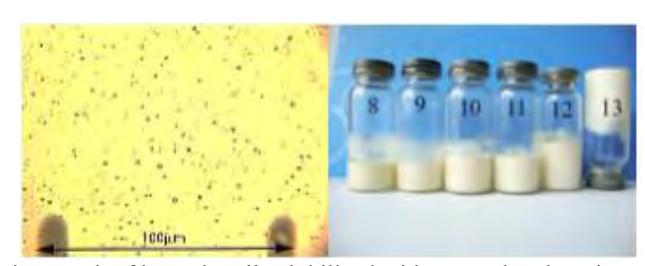
Highly concentrated, time-stable emulsions of vegetable fats and essential oils constitute a significant interest for the pharmaceutical, perfume and food industries. There are severe requirements for the stabilizers of these emulsions as far as it may contact human epithelium more or less. The use of synthetic ionic and combined stabilizers encounters certain concerns, due to their toxicity and capacity for accumulation in the body.
Therefore, developing of a similar emulsion based on pseudopolyaminoacids -amphiphilic polymers from the natural origin is of great interest. They constitute non-ionic surface-active compounds with a non-toxic tendency and inability to be deposited in interior or exterior organs due to their biodegradability. We used N-derivative of dicarboxylic α-amino acids, polyols and glycerine of different nature for their preparation. The preparation was carried out by using a Steglich reaction with N,N'-dicyclohexylcarbodiimide activator (DCC) in the catalyst of dimethylaminopyridine (DMAP). Branched pseudopolyamino acids as well as dispersed media on this basis have been synthesized from natural dicarboxylic amino acids and polyoxyalkylenediols, using glycerol as a trifunctional hydroxyl-containing comonomer that ensures the shaping a desired structure.
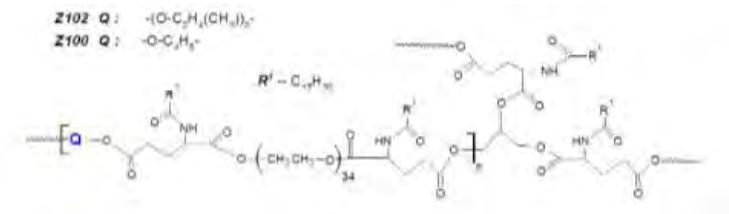
Above-mentioned stabilisers lead to formation a stable emulsions with 80% concentration of lavender oil. The size of the dispersed phase in the obtained emulsions was 3 μm. Figure 2 represents the procedure of exact lavender oil emulsion creation via applying described natural amphiphilic polymers as stabilisers.
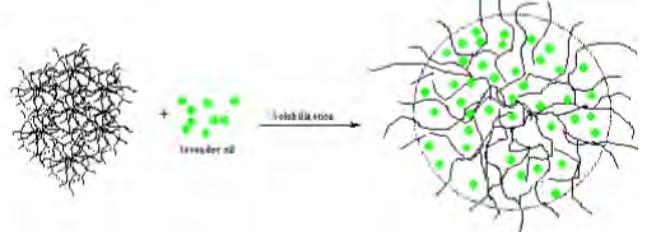
According to this scheme, the emulsion is generated due to solubilization or swelling of pseudopolyamino acid particles with a branched structure. The hydrophilic fragments (polyoxyethylene chains) are oriented at the interface due to which the oil in water is stabilized by the mechanism of a structural-mechanical barrier. The solubilizers (Fig. 3.b) remained stable during the study period (6 months). According to the thermogravimetric analysis, the solubilization of essential oil in the particles of the synthesized copolyester decelerates their evaporation compared to pure essential oils.
As all the above points have demonstrated, new pseudo-polyamino acids of a branched structure simultaneously act as stabilizers, solubilizers and aroma fixatives that allows to use it for developing high-quality water-based perfume compositions in cosmetics and perfumery.