
Bioactive compounds, among them and caffeic acid (CA), are becoming the focus of attention given their benefits to human health and their relative abundance in vegetables [1]. Presence of unsaturated bonds makes CA vulnerable to heat, oxygen and moisture, and influences instability especially at higher temperatures. In recent years delivery systems based on complexes formed by electrostatic interactions between polysaccharides and low molecular weight compounds gained a lot of interest [2] and chitosan (CHT) is one of biopolymers that can be ionized and possess positive surface charges. Investigation of thermal properties of complexes formed between CHT and CA are important for the pharmaceutical and food industries, as their concentration in complexes can change significantly during heat treatment. Such investigation can provide the information about the optimal temperature range during processing and storage [3]. Thermogravimetric (TG) analysis method has been used to evaluate complex formation between chitosan and other compounds.
The aim of the present work was to investigate thermal properties of CA and CHT complexes of different composition (further referred as CA-CHT) using TG analysis method. CA-CHT with the molar ratio of CA to CHT equal to 0.23/1 and 0.72/1 were obtained by using multistep adsorption process. TG analysis of CHT and CA-CHT was performed with a Perkin-Elmer (TGA 400, USA) instrument. Measurements were carried out at heating rates of 2.5 °C/min, 5 °C/min, 10 °C/min and 20 °C/min under nitrogen (air in some experiments) atmosphere. About 10 mg of air-dried sample was used. Apparent activation energy ($E_{a}$) was determined according to Flynn-Wall-Ozawa (FWO) method [4] in the temperature interval of 200–400 °C.
TG curves of CHT and CA-CHT (0.23 mol/mol) in nitrogen and air atmospheres are presented in Fig. 1. Thermal decomposition of CA-CHT (0.23 mol/mol) in nitrogen atmosphere and in air proceeded in two and three stages, contrary to CHT which decomposed in one and two stages, respectively. An extra step in the temperature range of 150 °C–200 °C in TG curves of CA-CHT (0.23 mol/mol) in both atmospheres occurred due to decarboxylation of adsorbed CA.
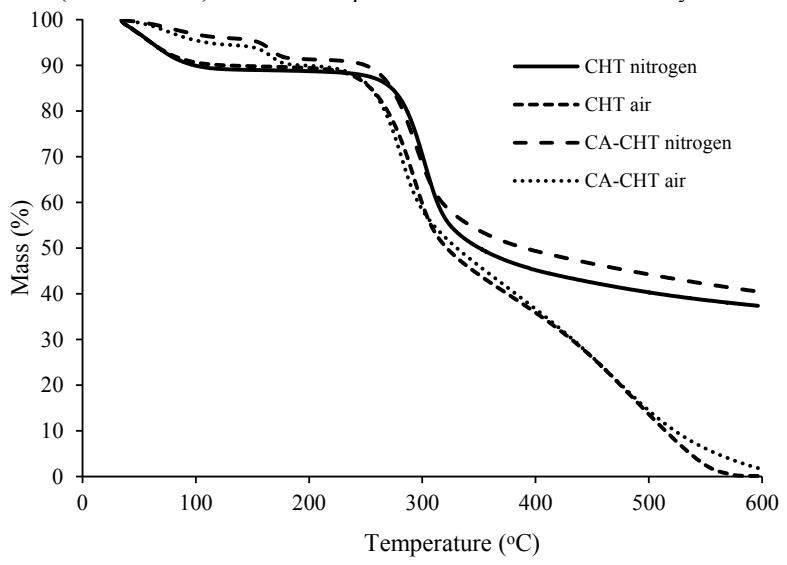
Values of $E_{a}$ related to the second stage of thermal decomposition of CA-CHT at conversion values ($\alpha$) from 0.1 to 0.8 were determined by Flynn-Wall-Ozawa method. The dependence of CA-CHT between $E_{a}$ and $\alpha$ was very similar to that of CHT.