
Glibenclamide, also known as glyburide, is a sulphonyl urea drug used to treat type 2 diabetes. New ways to use this compound for inhibiting headaches or various inflammations are also being found [1]. Unfortunately, glibenclamide is poorly soluble in water (15-24 μg/mL) [2] which makes it harder to find new pharmaceutical applications. To improve solubility of glibenclamide, a biological choline-tryptophanate ionic liquid was added to water, increasing glibenclamide's solubility to 27 mg/mL – by 130-600 times compared to the solubility in pure water [3].
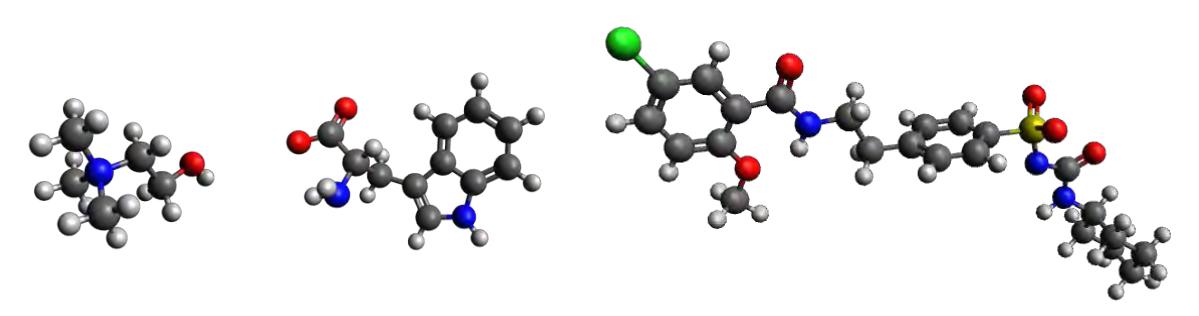
The main goal of this study was to find out what intermolecular interactions result in the increase of glibenclamide's solubility in aqueous mixtures with ionic liquid by using molecular dynamics (MD) simulations and quantum mechanics/molecular mechanics (QM/MM) methods. One of the main tools for studying intermolecular interactions is nuclear magnetic resonance (NMR) spectroscopy as 1H NMR chemical shifts depend on the surroundings of the molecule. The NMR parameters of two systems: glibenclamide in aqueous solution (Glbaq) and in ionic liquid mixture with water (GlbIL/aq), as well as additional structural parameters, were computed and investigated. NMR experiments for these systems were also done.
By analysing the dihedral angles between glibenclamide atoms, it was found that there are no significant changes between the conformations of glibenclamide in Glbaq and GlbIL/aq systems. The calculated coordination numbers between the glibenclamide and solvent atoms and the shift of glibenclamide's magnetic shielding constants let us conclude that the increase of solubility of glibenclamide in ionic liquid mixtures with water is impacted by intermolecular interactions between choline and tryptophanate ions and the amide groups, aromatic rings and cyclohexane cycle of glibenclamide.