Iron hexacyanoferrate (Prussian blue (PB)) is an inorganic, electrochromic compound, which is selective for several monovalent ions (Cs+, Rb+, K+ and NH4+). These ions (Cs+, Rb+, K+ and NH4+) are incorporated in the crystal lattice of PB when PB is electrochemically reduced in Cs+, Rb+, K+ or NH4+ ions containing solution [1]. Moreover, the concentration of PB reduction promoting ions (Cs+, Rb+, K+ and NH4+) affects the reduction potential of PB. For this reason, PB can be used as a signal transducer in optical and electrochemical analytical systems, such as electrochemical ion sensors [2]. Thus, Prussian Blue is often used as a redox mediator and signal transducer in biosensors, for example urea and glucose biosensors [3, 4].
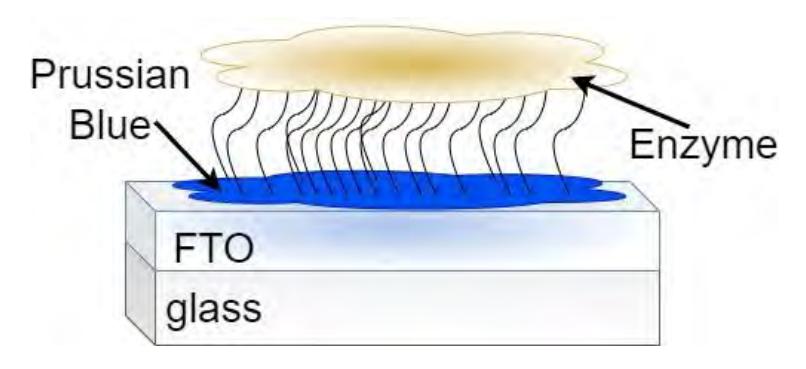
In this research work, Prussian Blue was used in formation of glass/FTO/PB/enzyme type electrodes, for the analysis of glucose and urea (Fig.1). Furthermore, these studies introduce the glass/FTO/PB/GOx electrode for optical glucose sensing and the glass/FTO/PB/urease electrode for electrochemical sensing of urea by using electrochemical impedance spectroscopy.