
Carotenoids (Cars) have linear conjugated isoprenoid chain that affords them an intense absorption in the blue-green range, and the colors they confer on fruits, flowers and animals lie at the basis of complex signaling processes. In photosynthetic organisms, they are implicated in the harvesting of solar photons while natural carotenoids display a large structural diversity, and more than one thousand molecular species have been now identified [1]. Typically, Cars are insoluble in water, and the complexation of lycopene with β-cyclodextrin is one of the strategies to resolve the problem [2].
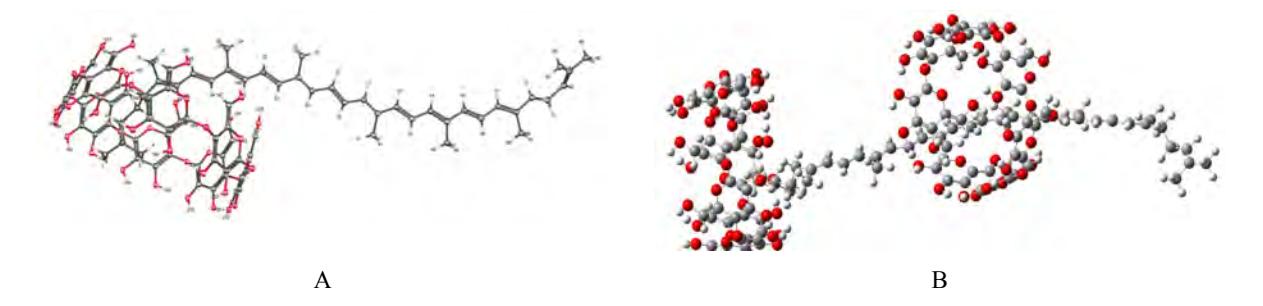
The Car was chosen lycopene (Fig.1). The complexes between cyclodextrin and lycopene were made artificially. All structures were optimized separately. Careful orbital analysis allowed us to label all calculated excited states. We chose the B3LYP and CAM-B3LYP functionals with cc-pVDZ basis sets for the present study which are available in the Gaussian package. All analyzed complexes were without imaginary frequencies. Study was done using a combination of resonance Raman and absorption spectroscopy and density functional theory (DFT) modelling by using B3LYP methodology, and CAM-B3LYP for AMBER molecular dynamics (MD).
Here we will present MD analysis and computational details for lycopene with several cyclodextrin. This study provides the framework to explain Raman $\nu_1$ changes in the lycopene complexed with β-cyclodextrin and γ-cyclodextrin. This study aims to further our understanding of the sensitivity of Raman $\nu_1$ band to Cars' distortions into its symmetry perturbations and lycopene crystal preparations.