Rechargeable Li-ion batteries, employing organic electrolytes are considered one of the main electrochemical energy storage devices, due to their high efficiency, energy density, and stability. However, for large-scale stationary applications, all these attractive properties are overshadowed by price and safety of operation, which are of paramount importance. Aqueous Na-ion batteries are deemed as one of the main alternatives, satisfying both of the conditions by employing sodium and aqueous solutions as a charge carrier and electrolyte, respectively. Despite the development of novel electrolyte systems, suppressing gas evolutions, and expanding operating window [1], the absence of high potential and stable cathode materials remains a bottleneck for fully utilizing and deploying this technology.
For Li-ion batteries, Co and Ni-based materials are the most successfully utilized due to their high operating voltage and stability. However, in recent years, considerable effort has been made to develop rare-earth-metal free systems based on Mn, Fe and V. Mn offers the highest operating voltage however, unfavorable aqueous chemistry limits its application [2,3]. Vanadium offers 2nd best alternative in terms of operating voltage as well as relatively high stability.
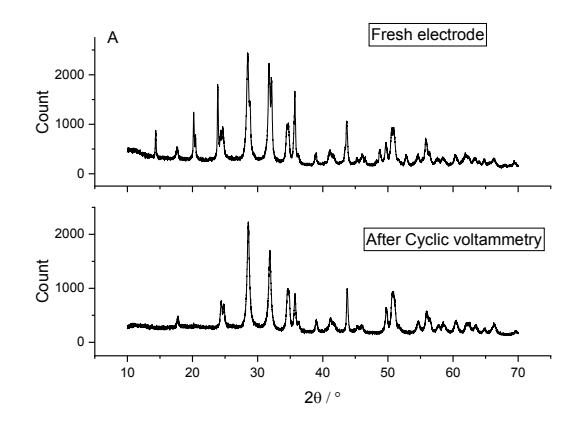
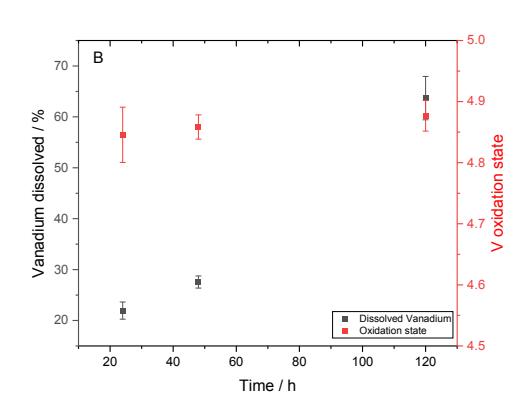
Here we report a chemical and electrochemical degradation study of Na3V2(PO4)3 (NVP) and Na3V2(PO4)2F3 (NVPF). Electrodes were prepared by a conventional slurry-casting method. The electrochemical activity of cathodes was characterized by galvanostatic charge-discharge cycling (GCD) and cyclic voltammetry (CV). Degradation was assessed by (XRD), ICP-OES, SEM/EDX, rotating ring-disc electrode (RRDE), and double redox titration of the electrolyte after measurement. Results show poor chemical stability of NVP in aqueous media, as well as rapid electrochemical degradation. RRDE study gave insight into the mechanism of degradation during operation. The introduction of fluoride in the lattice seems to relatively stabilize the structure, and suppress most of the chemical dissolution, however, electrochemical degradation remains significant.