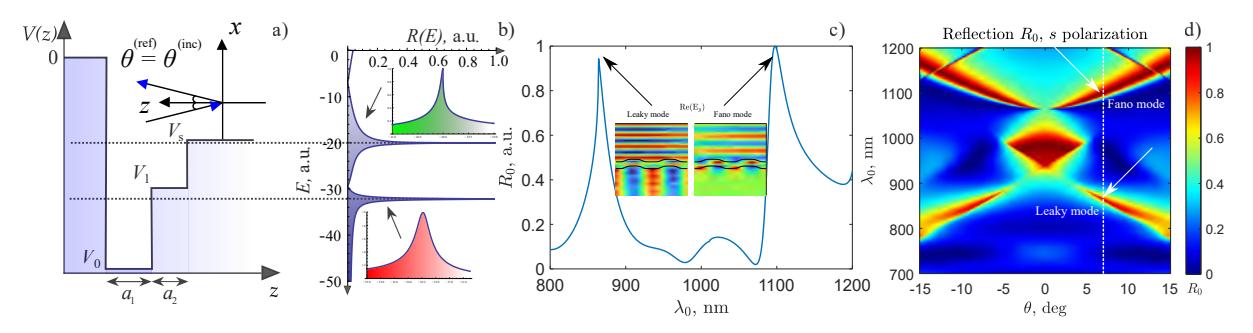
In this work, we primarily focus on the classical phenomenon of resonance shape, its origins, and its behavior in the thin dielectric films that exhibit transverse periodicity. The resonance itself forms whenever the incident light wave excites transverse propagating modes inside the device, which back-scatters it as a consequence. The reflection, induced by the device, corresponds to certain resonant modes which are quantified in the semi-analytical model borrowed from linear quantum mechanics: an asymmetrical quantum potential well in which the wave (i.e., propagating mode) could be localized. The schematic is shown in fig. (a,b), whereas the numerical results are shown in fig. 1 (c,d).
Fig. 1. Conceptual schematics of potential well (a), its resonant reflections (b), numerically calculated reflection coefficients at 6 deg (c) and their corresponding fields, as well as its reflection angular spectrum (d).
The idea of the analytical model is to define the shape of the resonance which is at the top edge (i.e. substrate) of the potential well, thus bringing forth the asymmetrical shape and leaky field behavior. Such an effect is achieved once the right parameters, such as the width, depth, and coupling coefficients of the well are properly tuned to match the resonance for desired wavelengths of the beam propagating perpendicularly about the well. The same effects are achieved for a light wave traveling across the periodic thin dielectric film device which, due to the quantum mechanism analog, couples the incident wave with a reflected one via excited wave-guide mode. Such behavior is thoroughly analyzed with Rigorous Coupled Wave Analysis [1] method and is experimentally realized via the Ion Beam Sputtering method, thus matching the simulated result. Practical applications of such resonances involve - sharp, narrow spectral beam filters, spatial light filters, polarizers, and light couplers [2-5].
[1] M. G. Moharam, Drew A. Pommet, Eric B. Grann, and T. K. Gaylord, "Stable implementation of the rigorous coupled-wave analysis for surface-relief gratings: enhanced transmittance matrix approach." J. Opt. Soc. Am. A12, 1077-1086 (1995).
[2] L. Grineviciute, J. Nikitina, C. Babayigit, and K. Staliunas. "Fano-like resonances in nanostructured thin films for spatial filtering". Applied Physics Letters. 118. 131114. 10.1063/5.0044032 (2021).
[3] L. Grineviciute, C. Babayigit, D. Gailevicius, M. Peckus, M. Turduev, T. Tolenis, M. Vengris, H. Kurt, and K. Staliunas. "Nanostructured Multilayer Coatings for Spatial Filtering". Advanced Optical Materials. 10.1002/adom.202001730 (2021).
[4] I. Lukosiunas, L. Grineviciute, J. Nikitina, D. Gailevicius, and K. Staliunas. "Extremely Narrow, Sharp-Peaked Resonances at the Edge of the Continuum" (2022). Submitted, https://doi.org/10.48550/arXiv.2211.01997.
[5] R. Magnusson, "Flat-top resonant reflectors with sharply delimited angular spectra: an application of the Rayleigh anomaly," Opt. Lett.38, 989-991 (2013).