DLC:CU THIN FILM STABILITY TESTING IN CELL CULTURE MEDIUM
Shahd Elkhider1, Mohamed A. Baba1, Andrius Vasiliauskas1, Šarūnas Meškinis1, Dainius Zienius2, Raimundas Lelešius2, Algirdas Šalomskas2, Tomas Tamulevičius1, 3
1 Institute of Materials Science, Kaunas University of Technology, Lithuania
2 Department of Veterinary Pathobiology, Faculty of Veterinary Medicine Lithuanian University of Health Sciences, Lithuania
3 Department of Physics, Kaunas University of Technology, Lithuania
Novel nanoparticles with significant antimicrobial properties are extensively studied in the last two decades due to their different properties from the bulk material in size reduction and high surface area [1, 2]. Copper (Cu) nanoparticles were found to have antiviral properties against a range of viruses [3]. The nanoparticle can increase the drug solubility in water and the drug uptake by the infected cell which can increase the biomedical application in drug delivery systems [4].
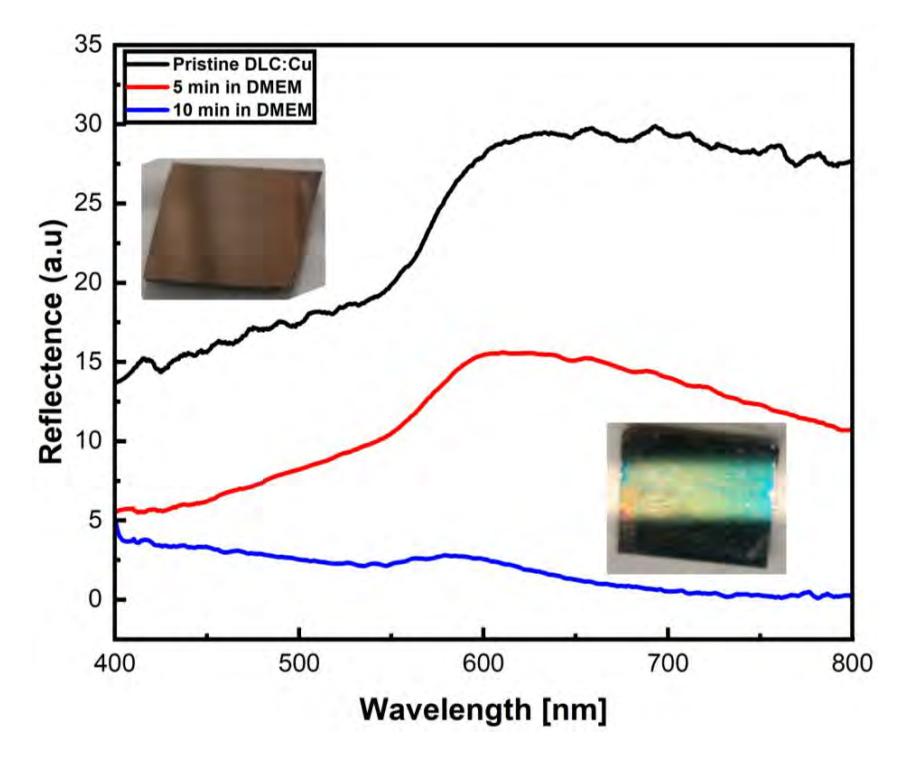
In this work, the amorphous diamond-like carbon thin films with Cu nanoparticles (DLC:Cu) were deposited on crystalline silicon substrates by reactive magnetron sputtering of a metal target in an acetylene gas atmosphere. The nanocomposite DLC:Cu films are intended for antiviral effect testing by cell culture method. The DLC:Cu film stability was tested using culture media Dulbecco's Modified Eagle's Medium (DMEM) for a different set of time durations (5 and 10 minutes). The sample changed color from metallic copper to green which was confirmed by the UV–visible spectrophotometry measurements (Fig.1). The initial results suggest that copper nanoparticles are oxidized. Copper oxidation, ion, and nanoparticle release in the medium are important for DLC:Cu application for antimicrobial and antiviral applications.
Fig. 1. Effect of the DMEM media on the reflectance of DLC:Cu nanoparticle film after different durations in time. Sample edge length 1 cm.
Acknowledgments: This work was supported by the European Regional Development Fund, Project No.: 13.1.1-LMT-K-718-05-0018.
[1] Rajesh, K.M., et al., Assisted green synthesis of copper nanoparticles using Syzygium aromaticum bud extract: Physical, optical and antimicrobial properties. Optik, 2018. 154: p. 593-600.
[2] Salavati-Niasari, M., F. Davar, and N. Mir, Synthesis and characterization of metallic copper nanoparticles via thermal decomposition. Polyhedron, 2008. 27(17): p. 3514-3518.
[3] Tavakoli, A. and M.S. Hashemzadeh, Inhibition of herpes simplex virus type 1 by copper oxide nanoparticles. Journal of virological methods, 2020. 275: p. 113688.
[4] Tortella, G., et al., Silver, copper and copper oxide nanoparticles in the fight against human viruses: progress and perspectives. Critical Reviews in Biotechnology, 2022. 42(3): p. 431-449.