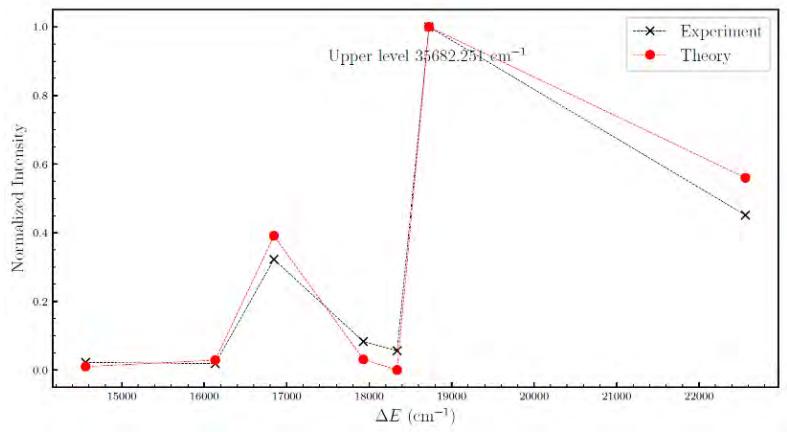
We report on experimental data and ab initio calculations on transition strengths of atomic thulium (Tm). Transition probabilities of lanthanide atoms, e.g., Tm, along with other spectroscopic data, such as identified transitions and fine structure energy levels, determined hyperfine structure (hfs) constants, etc. are important both from point of view of fundamental physics, as well as for astrophysical purposes. Relative line intensity distributions were obtained in Tm emission spectra ranged from 400 nm to 700 nm [1] applying high-resolution Bruker IFS 125 HR Fourier-transform spectrometer at the Laser Centre of the University of Latvia. The 169Tm emission spectra were produced in a hollow cathode discharge lamp in presence of either Ar or Ne buffer gases at different discharge current values. The nuclear spin of 169Tm isotope is $I = 1/2$ yielding a rather simple hfs, which has been studied experimentally by several authors (see [1] and references therein). Exploiting two different gases facilitated identification of those Tm lines, which exhibit completely overlapping hfs transitions. In present work we have determined relative intensity distributions in selected branches of Tm emission lines, which originate from a common upper level. We examined 3 branches from upper state levels with energies 32217.195 cm-1, 33943.282 cm-1, and 35682.251 cm-1. An example of experimental relative intensity distribution from the level 35682.251 cm-1 is presented in Fig. 1 (black crosses), along with ab initio calculations (red points). Calculations were done using a recently proposed modification of an approach that combines configuration interaction (CI) and many-body perturbation theory (MBPT) [2]. The ground state configuration of thulium is [Xe]4f136s2, so it was considered as a 15 active-electron system with a frozen Xe-like core. Due to a large number of the active electrons and opened f-shell the conventional CI approach can tackle only a relatively small configuration space (CS). In our approach, the active orbitals are divided into valence and virtual. The CS is constructed by making single and double excitations from few reference configurations to the valence orbitals and only single excitations to the virtual ones. Double excitations to the virtual orbitals are taken into account by means of MBPT. Once the many-electron wave functions of individual states are found, the transition amplitudes of the electric dipole lines are calculated using the formalism of transition matrix.