
Chalcogenides are compounds that are composed of anions from group VI (elements S, Se, Te) and less electronegative cations, e.g. metals. Chalcogenides are widely applicable in various fields from thermoelectrics, infrared sensors to UV-light emitters. One of the advantages of chalcogenides are that that they can easily form alloy systems without changing original crystal structure. Due to chemical similarities of sulfur and selenium, substitution one with the other does not induce significant structural changes but enables to modulate bandgap in 0.3 – 0.8 eV range [1]. The same trend applies if substitution is carried out with isovalent cations. ABX3 where A=Ca, Sr, Ba, Sn, B=Ti,Zr, Hf and X=Se, S is a novel group of chalcogenides poised to have very promising properties for optoelectronic application.
In this work we focus on analyzing SnZrS3-SnTiS3 alloy system with an aim to modulate absorption edge and identify potential application fields. To achieve this goal, a solid state reaction was carried out in 750 – 850 °C temperature range to synthesize Sn(TixZr1-x)S3 alloys. To facilitate reaction, a transport agent was introduced in the synthesis process. The as-obtained samples were studied using X-ray diffraction method, X-ray energy-dispersive and diffuse reflectance spectroscopies.
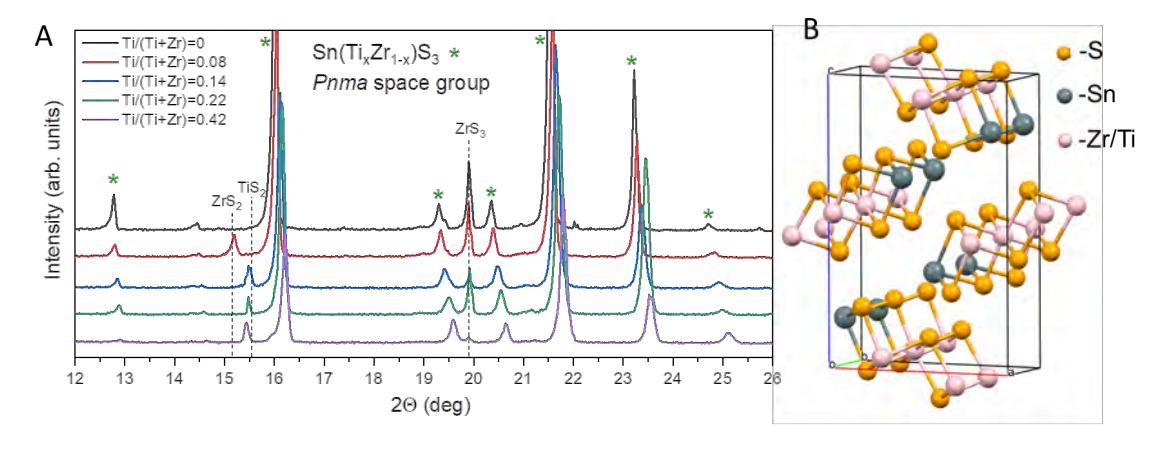
Parent structures of SnZrS3 and SnTiS3 are not the same. SnZrS3 crystallizes in orthorhombic crystal structure based on a needle-like phase (prototype structure – RbCdCl3), whereas SnTiS3 is found in two phases: more common is misfit compound of (SnS)1.2TiS2 (monoclinic) [2] and under certain conditions – a needle-like phase with Sn1.2Ti0.8S3 stoichiometry can be obtained [3]. We found that while Ti content was low, i.e. Ti/(Ti+Zr) ratio was below 0.5, the major phase was Sn(Ti,Zr)S3 in needle-like phase with a small contribution of secondary binary phases (Fig. 1). When Ti content was above 0.5, we observed a new phase formed which was most likely related to the misfit compound of (SnS)1.2(TixZr1-x)2 nature. Therefore we estimate that a single phase in Sn(TixZr1-x)S3 can be obtained with x up to 0.5.
Absorption spectra of powder samples were estimated by measuring diffuse reflectance and applying a Kubelka-Munk formulation. We found that absorption edge gradually shifted towards lower energies with the increasing Ti content. Finally, the estimated bandgap varied in 0.8 – 1.4 eV range depending on the Ti concentration. We show that bandgap can be modulated in the wide range depending on the cationic Ti/(Zr+Ti) ratio without compromising crystal structure. This demonstrates the potential of Sn(TixZr1-x)S3 alloy system for optoelectronic application in near infrared and infrared regions.