
Intensive studies and the application of $\pi$-$\pi$conducting polymers such as polyaniline (PANI) and polypyrrole (Ppy) has been developed extensively during the last few decades [1]. Conducting polymers are used for immobilization strategies and biosensors development [2]. In the process of the enzyme-assisted synthesis of polymers, the suitable monomer is attacked by a radical cation induced by H2O2 [3]. Gold nanoparticles (AuNPs) able speed-up the polymerization of monomers [4]. Polymeric nanocomposites based on noble metal nanoparticles embedded within polymers are characterized by unique properties, electrical conductivity, high surface area and flexibility [5].
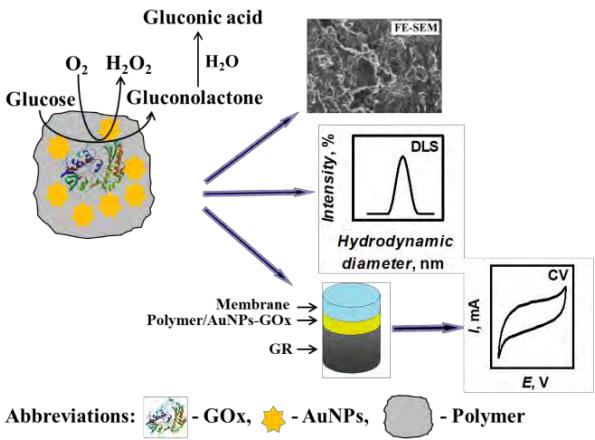
The main aim of this research was to evaluate the morphology, hydrodynamic diameter and the electrochemical characteristics of enzyme-assisted polymeric nanocomposites (Fig.1). For this purpose polyaniline and polypyrrole nanocomposites with embedded glucose oxidase (GOx) and gold nanoparticles were formed by enzymatic polymerization of corresponding monomers in the presence of 0.46 x 10¹⁶ particles L-1 6 nm diameter colloidal gold nanoparticles (AuNPS(6 nm)) or 0.6 mmol L-1 solution of tetrachlorauric acid. Enzymatically formed Ppy- and PANI-based nanocomposites were of spherical and lamellar forms and are attractive for the use. It was investigated by dynamic light scattering method, that by an increase of polymerization time until 4.5 days the hydrodynamic diameter of PANI/AuNPS(6nm)-GOx, PANI/AuNPS(AuCl4-)-GOx, Ppy/AuNPS(6nm)-GOx and Ppy/AuNPS(AuCl4-)-GOx nanocomposites grew up to 1128, 659, 594 and 388 nm [6]. The measurements performed using cyclic voltammetry confirmed high charge transfer ability of synthesized polymeric nanocomposites. It was investigated, that during enzyme-assisted polymerization the conversion of PANI leucoemeraldine form to emeraldine salt took place; the transition of cation-polaron into cation-bipolaron-based state of Ppy is ongoing.
Characterized by good yield of polymerization reaction and high purity from surfactants developed nanocomposites can be applied in the future for wide range of applications including various biomedical fields, development of biosensors and biofuel cells.