
Pulse compression based on stimulated Brillouin scattering (SBS) in counterpropagating ns pump pulses [1] makes it possible to achieve a pulse width of ~110 ps in liquids such as perfluorooctane C8F18 [2] and carbon tetrachloride CCl4 [3], as well as ~180 ps in fused quartz [4]. The most studied CCl4 is toxic for use in medical lasers, is not suitable for phase conjugation in two-pass amplifiers as it is prone to optical breakdown and has a low reflectivity ~40% of the SBS-mirror. In contrast, the safety of C8F18 has been proven by its use as a coolant, tamponade in eye surgery and even as a breathable fluid. The high breakdown threshold and reflectance above 90% allow it to be used in high-energy >200 mJ two-pass phase-conjugated amplifiers [2]. Self-seeding of the SBS-compressor with CCl4 allows to improve energy stability, reduce jitter, and achieve shorter pulses [3], albeit with an energy limited to ~1 mJ. The goal of this study was to compare different designs of self-seeded SBS-compressors with C8F18 to ensure ~90 ps high-energy pulses with a smooth beam suitable for laser dermatology and interference patterning.
Three different self-seeding SBS-compression configurations were experimentally studied (Fig. 1): with a focusing lens (F3) and a flat mirror (PM) returning the pump radiation passed through the SBS-cell (Fig. 1a), with variable splitting of the pulse into seed and pump, followed by their spatial overlap in the SBS-cell and tuning of the relative delay (Fig. 1b) and with a spherical mirror (SM) returning the pump radiation passed through the SBS-cell (Fig. 1c). Input pulses: ~2 mJ, ~1.1 ns at 10 Hz of TEM00 SLM Nd:YAG laser were used.
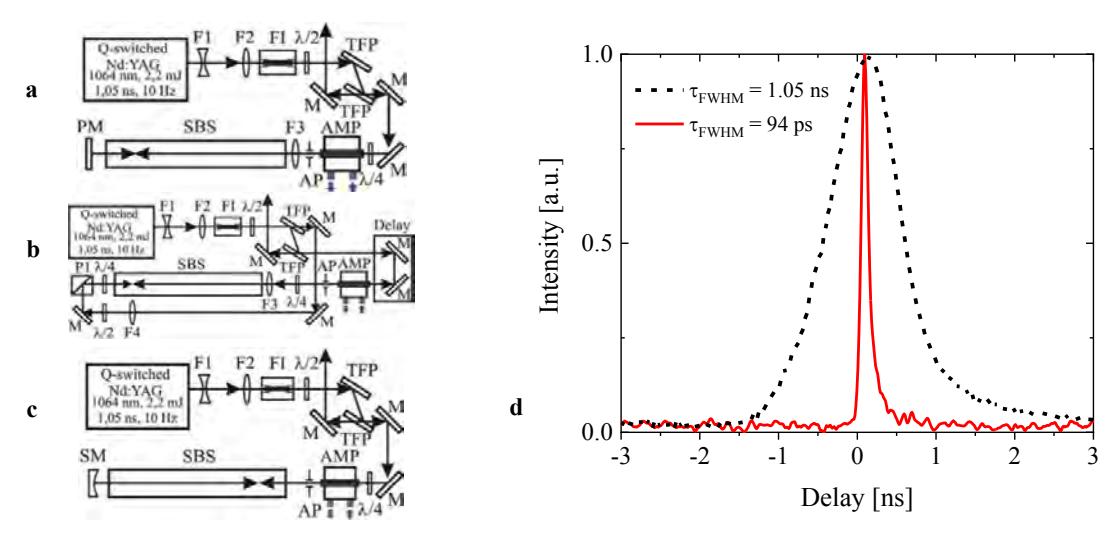
In any of the studied SBS-compression configurations, self-seeding reduced the SBS threshold and improved the reflectivity. Despite the expectations associated with more complex seed injection schemes (Fig. 1b, c) and in contrast to [3], the shortest pulse width of ~94 ps and the highest energy ~9 mJ of compressed Stokes pulses were obtained (Fig. 1d) in the simplest scheme with a return flat mirror (Fig. 1a). When using two consecutive phase-conjugated Nd:YAG amplifier modules, the output energy of compressed pulses can reach ~50 mJ at a pulse width of ~100 ps.
The developed layout will later be used for high-throughput interference patterning of the metal surface in order to impart water-repellent properties. This project received partial funding from the Research Council of Lithuania, agreement S-LU-22-3 and 01.2.1-MITA-T-852-01-0174.