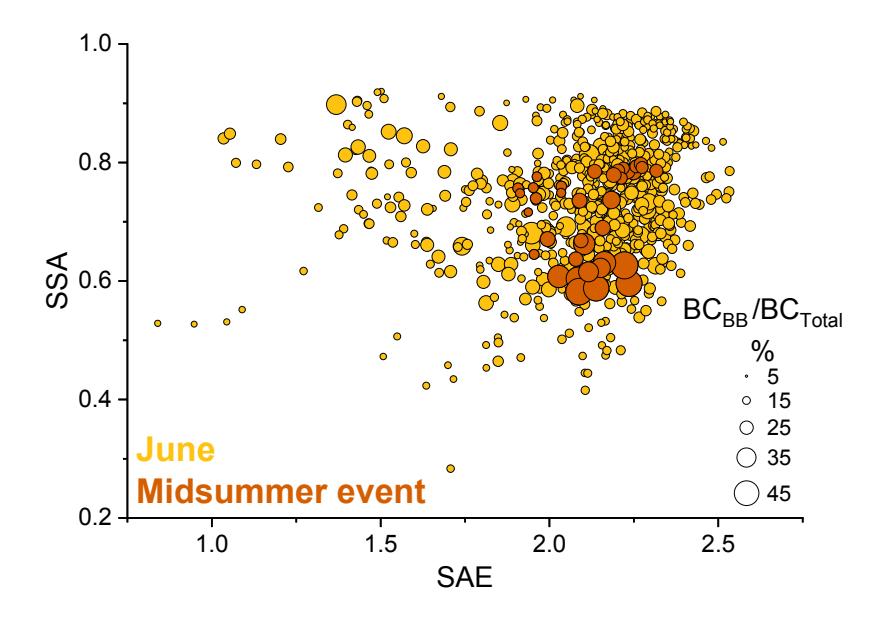
Aerosol particles can scatter or absorb light depending on their chemical composition. Meanwhile, the chemical composition is highly dependent on the source [1]. It is widely known that sulphate and nitrate contribute significantly to light scattering. Even though there are numerous studies on aerosol particles originating from biomass burning, a consensus on the strength of the radiative effect of the aerosols has not been reached [2]. The case study investigates the impact of an extensive nationwide bonfire-burning event, associated with the celebration of Midsummer, on the aerosol black carbon (BC) mass concentration and optical properties at an urban background site. Aerosol BC mass concentration was measured using an Aethalometer (AE33, Magee Scientific); aerosol scattering properties were recorded using a Nephelometer (TSI model 3563); the aerosol particle number size distribution was evaluated using a condensation particle counter (CPC, TSI model 3085) and a differential mobility analyzer (DMA, TSI model 3085). The changes in aerosol BC source contribution, light absorption coefficient, absorption and scattering Ångström exponents (AAE and SAE, respectively), single scattering albedo (SSA), and particle number size distribution were analyzed during the period from 1st to 30th June 2022. The Midsummer celebration took place on the night of 23rd June when a 3-fold increase in the total BC mass concentration was observed. Moreover, the extensive bonfire burning resulted in a 7-fold increase in BCBB (BC originated from biomass burning) level compared to the monthly average value. The high contribution of BCBB to the total aerosol BC appears to increase aerosol light absorption. Thus, it performs a warming role in the atmosphere as the SSA value decreased to 0.62. This multi-parameter investigation focuses on the high pollution event when biomass-burning aerosols originated nationwide in a rather short time scale. The results provide a better perception of the biomass-burning-related aerosol characteristics in the ambient atmosphere and their impact on atmospheric radiative transfer.