
The research is devoted to the development of technology for producing hydrogel therapeutic agents with high physical and mechanical properties on the basis of acrylamide copolymers. An increase in the physico-mechanical properties of polyacrylamide hydrogels is achieved by covalent grafting of the gel-forming polymer to the polypropylene surface. Hydrogel structure provides biocompatibility with tissues of living organism, the ability to adsorb and release drugs, atraumatic technique; the reinforcing polymer material provides necessary mechanical strength during the technological operations in the production and application of this hydrogel material. A peculiarity proposed in this work is the covalent attachment of the gel-forming polymer to the polypropylene surface allowing the resulting material to be integrated in a coherent structure and thus obtaining the characteristics of a composite.
In this paper presents the experimental results regarding the comonomers radical copolymerization, which is simultaneously initiated by two peroxide initiators. One of the initiator is localized in the reaction volume, and the second one is covalently grafted to the polymer surface. The following items are discussed in this section: the dynamics of the of acrylamide polymerization process; copolymerization of acrylamide, N,N-methylenebisacrylamide and potassium acrylate; the formation of polymer network points; the effect of process conditions and reaction mixture composition on the time and conversion of gelation. The comparison of the formation rates of the gel-forming polymer macromolecules, which were initiated from the reaction volume and from the surface of the reinforcing material, was of special attention. It is shown that the consistency of mentioned two processes is the basis for hydrogel grafting to the surface.
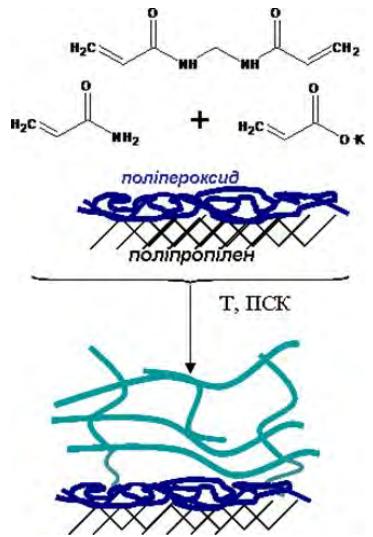
A mathematical model for the formation of polymer network of acrylamide, N,N-methylenebisacrylamide and potassium acrylate copolymer was obtained using statistical methods. The model well describes the experimental data and explains the nature of the main factors effect on the time and conversion of gelation, as well as the ratio between sol- and gel-fractions during the whole hydrogel formation process.
Based on the experimental results and predictive data generated by the mathematical model, the basic regularities of the formation of a three-dimensional hydrogel network (formation of polymer molecules, cross-linking) before the system gelation (conversion > 5-7%) and after it till deep stages of copolymerization (conversion> 75-85%) were examined. Dependences of the basic parameters of the hydrogel formation (rate, copolymer composition, average degree of polymerization, density of cross-linking, ratio between sol and gel fractions) on the process conditions were obtained. This allowed to demonstrate that the grafting to the surface is realized after the gel point and the majority of covalent bonds that provide the grafting of the gel-forming polymer to the surface is formed in deep stages (conversion > 75-85%).