
In recent years, photopolymerization engendered high interest due to the considerable practical and economic benefits. It is characterized by rapid cure, low energy consumption, high efficiency, low volatile organic compound emission, and the large number of applications not only in conventional areas such as coatings, inks, and adhesives, but also in high-tech domains, such as microelectronics, optoelectronics, laser imaging, stereolithography, and nanotechnology [1]. The renewable feedstock use in materials production using photopolymerization processes reveals the great potential of renewable raw molecules and their ability to substitute petrochemical-based materials [2]. Glycerol, the by-product of biodiesel refining is a promising candidate which can be used as monomer in the synthesis of polymers as it is or after chemical modification [3].
In this work, three glycerol acrylates having different number of acryl groups: 2-hydroxy-3-phenoxypropyl acrylate, glycerol 1,3-diglycerolate diacrylate, and glycerol trimethacrylate, have been photopolymerized with addition of vanillin styrene in order to obtain copolymers with improved mechanical and thermal properties. The homopolymers of glycerol acrylates have been synthesized for comparison. Diphenyl(2,4,6–trimethylbenzoyl)phosphine oxide was used as photoinitiator. The chemical structure of monomers is presented in Fig 1.
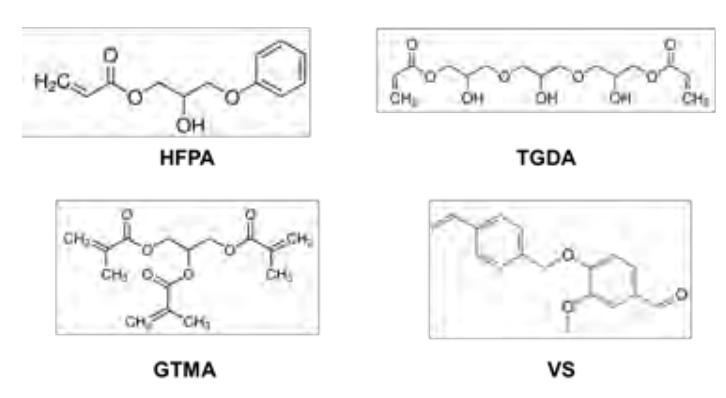
The structure of the homopolymers and copolymer was confirmed by FT-IR spectroscopy, Soxhlet extraction, and swelling test. It was determined that the insoluble fraction of the resulting copolymers depended on the number of functional groups of the glycerol acrylate used and ranged from 93 % to 97 %. The degree of swelling of the copolymers in toluene was very low (0,45-4 %) while that of the homopolymers was a bit higher (0,2-14 %) and depended on the number of functional groups of the monomers used. The copolymers obtained using mono- and difunctional glycerol acrylates had a higher density of cross-links and less swelled than the homopolymers of the corresponding glycerol acrylates. In the case of trifunctional glycerol acrylate, the results were reversed.