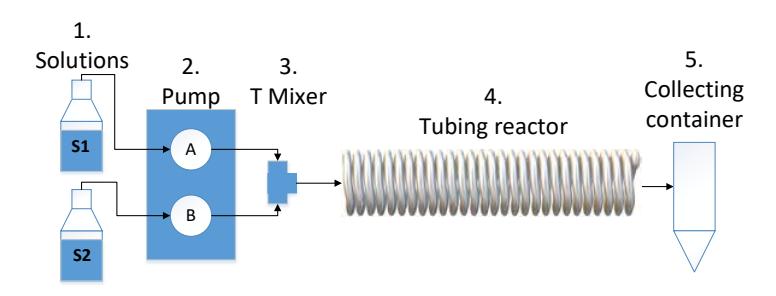
Base catalysed polymerized silica sol-gel can be used to form variety of end products such as film, particles coating, wet gel or polymeric colloidal silica particles [1]. Methods to synthesise mesoporous silica microspheres using organo-trialkoxysilanes and tetraalkoxysilanes is well described in multiple literature sources [2,3]. Nevertheless, reproducible synthesis of well-defined particles is a challenging task due to kinetic and thermodynamic factors.
Continuous flow systems could produce narrower particle size distributions compared to batch reactors in the Stöber synthesis of silica particles using the same reactant compositions and experimental conditions. According to literature the use of continuous flow led to lower polydispersity, higher inter-run reproducibility and lower synthesis times, compared to the batch system. These results can be explained on the basis of a better mixing and a higher surface to volume ratio in the tube reactor system, leading to shorter nucleation times and to a higher homogeneity (composition, temperature) in the reaction mixture [4].
This investigation is focused on base catalysed silica microspheres synthesis using continuous flow synthesis method. To achieve the goal reactors multiple designs were investigated to synthesize silicon dioxide microspheres. Silicon dioxide microspheres were synthesized using Stöber process [5]. In this work several designs of reactors were compared against clogging, residence time, flow speed and reactor length. Clogging was analysed visually; particles size distribution was analysed using laser particle sizer and morphology were analysed using scanning electron microscope.