
Valeric acid or pentanoic acid (C5H10O2) is one of the simplest saturated carboxylic acids. Carboxylic acids are often studied using vibrational spectroscopy since they serve as very good model systems in order to understand processes in more complex molecular structures1. Most of the last two-decade matrix isolation studies concentrate on hydrogen bond in the light acids, starting from formic and ending at propionic. The larger acids have been studied much less due to the additional complications2 arising from possibility of having several different conformers, thus making assignment of the vibrational spectra far from straightforward. The main objective of this work is to identify the possible structures (see fig. 1) of the valeric acid using matrix isolation infrared spectroscopy combined with ab initio calculations.
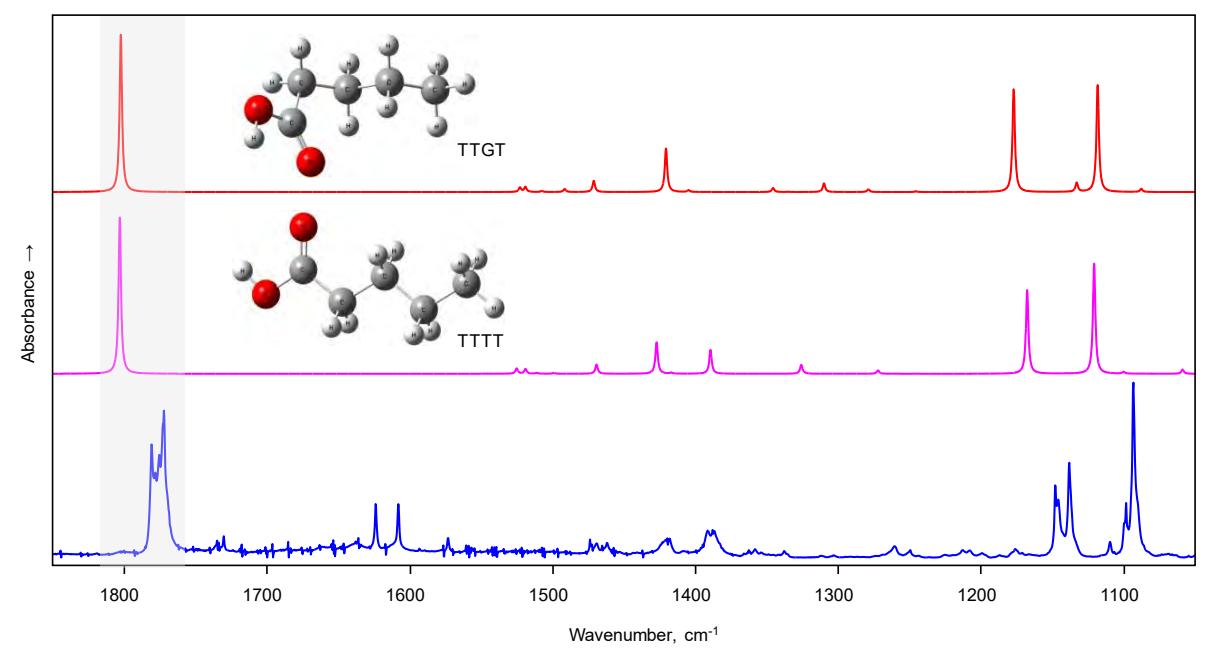
The theoretical calculations were carried out using two different methods. First of all, DFT calculations were performed using the B3LYP functional and an augmented Dunning correlation matched valence double zeta basis set. The further calculations were continued using the MP2 - Møller-Plesset expansion extension which contains truncated second orders, supplemented with the Dunning correlation matched basis set (triple zeta).
The MP2 calculations show that the TTGT conformation has the lowest energy. The second lowest energy conformer is TTTT, which is $\Delta E$ = 1.6 k J/mol higher in energy than TTGT. Experimental FTIR spectra of valeric acid isolated in argon, nitrogen and neon matrices were recorded. Comparison of the experimental spectra with calculated ones of the two lowest energy conformers (see fig. 1) allowed us to identify bands belonging to the both conformers. The band corresponding to C=O stretching vibration at 1802cm-1 for TTGT and 1803 cm-1 for TTTT conformer. In the experimental spectra, there are definitely more bands in the 1850-1750 cm-1 spectral region than was predicted by the calculations. The 1772 cm-1 band, for example, was assigned to the TTGT conformer band and 1773 cm-1 assigned to TTTT conformer bands. Such findings allowed us to conclude that at least two conformers of valeric acid coexist in low temperature matrices, with different concentrations that can be explained taking in to account different stability of the conformers.