
Looking at modern technologies and their development, miniaturization is integral, and research related to micro- and nano-sized elements is important in different fields such as electrotherapy and drug delivery [1], sensors [2], etc. Expanding and promising areas of technology encourage the study of micro- and nano-sized channels. Since the flow regimes in small fluid volumes are often laminar, fluid heat exchange is limited [3]. Acoustofluidic physics can be used to achieve an efficient mixing process for fluid flow in straight nanopores [4, 5].
In terms of anodic aluminum oxide (AAO) pore geometry, AAO pores can be characterized by a width-to-length ratio. The pore diameter of AAO membranes can be from tens to several hundreds of nanometers, and the length can be several tens of μm [6]. It results in limited liquid renewal at the bottom of the pore during the two-step anodization process. Therefore, the application of acoustofluidics to fabricate porous AAO membranes during the anodization process can be used to overcome the limitation. Furthermore, the effect of the vibrations used during the anodization process on the pore geometry is still in its early stages.
Thus, a study of the mixing process of fluid flow in a nano-diameter pore using vibration is presented. After performing theoretical calculations, the change in acoustic pressure, acoustic velocity, and velocity magnitude along the entire length of the pore was determined. The fluid flow velocity contour is presented in Fig. 1. Moreover, comparative curves of different frequencies are shown in Fig. 2.
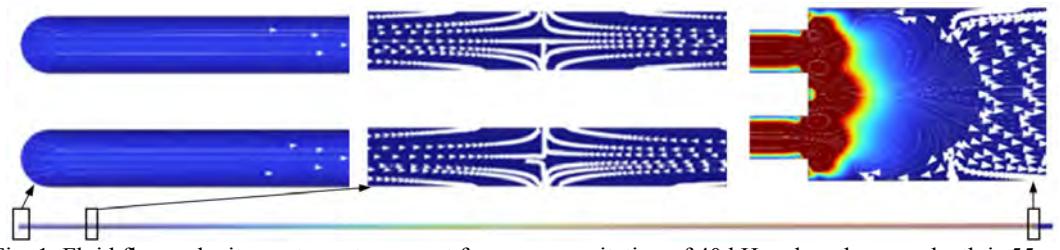
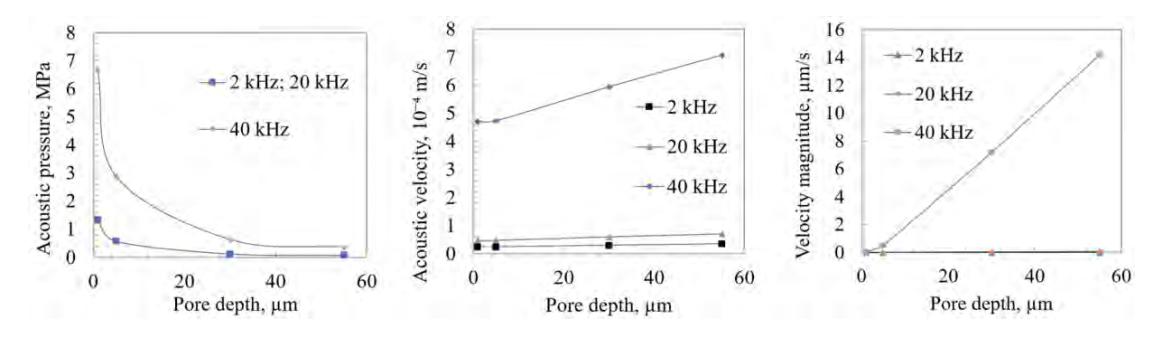
The results of the numerical simulation showed that the mixing process of the fluid flow in the pore was ensured by using vibrations. Therefore, the electrolyte concentration in the pores was also updated during the mixing process. It can be assumed that vibrations during the anodization process could ensure a more uniform distribution of the electrolyte temperature and pH values along the entire length of the pores.