The AlSi10Mg alloy is frequently subjected to post-processing after Selective Laser Melting (SLM) in order to enhance its mechanical performance. Hot isostatic pressing is the most commonly used method for plastic deformation processes[1], however, this approach results in a notable decline in strength. To enhance the mechanical properties of various metals, Equal Channel Angular Pressing (ECAP) or Equal Channel Angular Extrusion (ECAE) are often employed as they result in refined microstructure and higher dislocation density[2].
The objective of this study is to enhance the mechanical properties of AlSi10Mg alloy produced by Selective Laser Melting (SLM) by undergoing post-processing using Equal Channel Angular Pressing (ECAP). The research evaluated two post-processing approaches: low-temperature annealing (LTA) followed by ECAP treatment at 150°C and ECAP treatment without heat treatment at various temperatures of 350°C, 400°C and 450°C.
The microstructure and mechanical properties of the alloy were analyzed after each post-treatment stage. The results from metallographic observations, Scanning Electron Microscopy (SEM) and Electron Backscattered Diffraction (EBSD) showed that SLM-produced alloys have a unique cellular microstructure composed of Si networks surrounding an Al-based matrix phase.
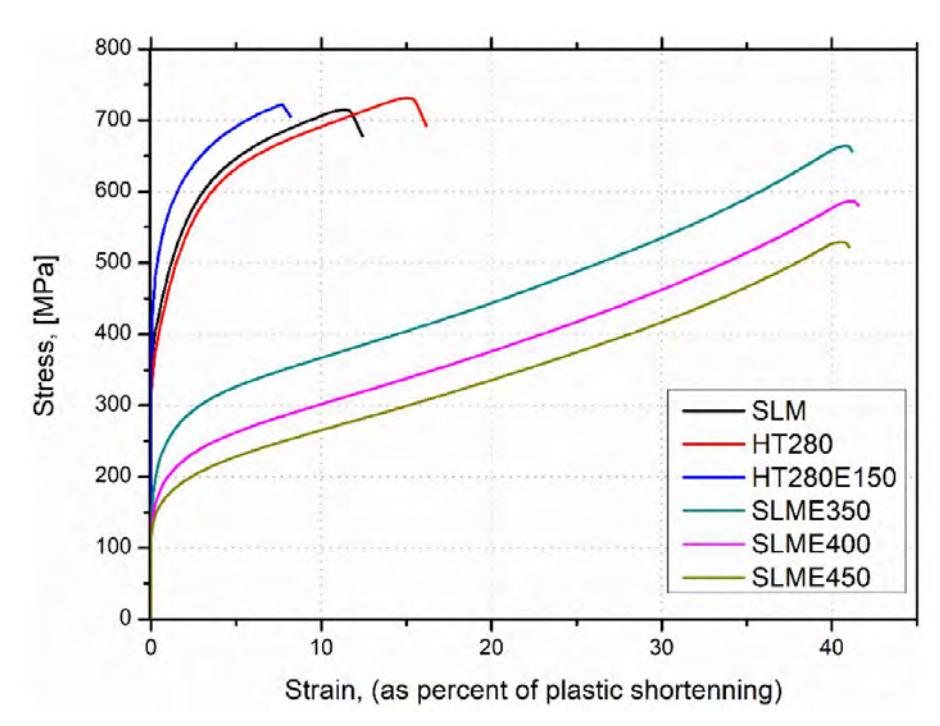
LTA followed by ECAP treatment promoted the microstructural development of the alloy, leading to the partial breakup of the Si network and the nucleation of $\beta$-Si precipitates throughout the Al matrix. This resulted in a Vickers microhardness of 153 HV and a yield strength of 415 MPa (shown in Fig. 1). These values are among the highest reported in literature for this alloy. The findings indicate that post-processing of SLM-produced AlSi10Mg alloys using ECAP has a significant impact on the microstructural evolution and mechanical properties of the alloy.