
In cancer treatment, the primary goal is to find an effective way to reduce the size of a cancerous tumor by leaving no side effects. Since bleomycin is cytotoxic, it is frequently used in chemotherapy to treat cancer [1]. Despite the fact that bleomycin reduces or stops the growth of a tumor, drug can lead to severe or fatal side effects, such as pulmonary injury progressing into pulmonary fibrosis [2]. Chemotherapy has a variety of side effects that slow down the time necessary for recovery.
Calcium (Ca2+) ions are immensely vital for normal cell and tissue function being an intracellular second messenger that is involved in signal transduction pathways and many cellular metabolic processes [3]. Ca2+ is currently used in anti-cancer treatment: calcium electroporation has been proven to be an effective anti-cancer treatment method [4].
Sonoporation (SP) involves non-invasive application of medical ultrasound (US) in combination with microbubbles (MBs) in order to attain spatio-temporally controlled anticancer drug delivery to cells and tissues. Although SP could have greater potential in treating cancer than electroporation, Ca2+ delivery and possible applications for sonotherapy are poorly investigated. The employment of Ca2+ for cancer treatment would allow to significantly diminish detrimental side-effects, imposed by conventional cytotoxic drugs.
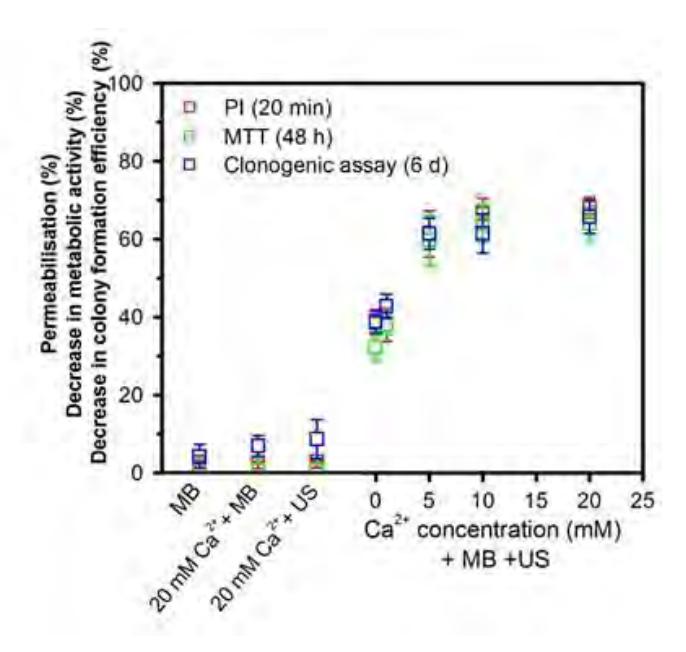
Our preliminary data indicate that Ca2+ (5 mM) induces rapid (within 20 min) cell death of Chinese hamster ovary cells as cell viability assays, performed at different time periods, indicate similar results (Fig. 1). Fast cellular response after Ca2+ delivery via SP would offer new opportunities for initiating effective and rapid (< 20 min) cell death by intrinsic Ca2+ activated mechanisms as compared to slow (24 - 72 h) cell death, induced by chemo- or gene therapy [5].