
Historically the budding yeasts Saccharomyces cerevisiae have been viewed as a prototype of eukaryotic cells, ideally suited for use in studies of many basic phenomena of eukaryotic life [1]. The S. cerevisiae yeast cells are surrounded by a cell wall, which provides them with protection from osmotic stress and is also important for their defense against toxic compounds, for self-recognition and for aggregation [2]. Permeability of yeast cells can be changed using many various methods. These include treatment of the cells chemically by adding reducing agents or antibiotics. Permeability can also be changed by increasing the external mechanical pressure on the cells. Pulsed electric field (PEF) treatment is known to cause plasma membrane permeabilization, an effect known as electroporation [3]. Tetraphenylphosphonium salts (for example, tetraphenylphosphonium bromide [TPPBr]) are frequently used in the measuring the membrane potential of prokaryotic and eukaryotic cells. The use of a potentiometric ion-selective electrode is also a convenient method for the quantitative evaluation of the permeability of the yeast cell wall and membrane [4].
In this study we, firstly, constructed a TPP+ ion selective electrode. Secondly, we measured TPP+ ion uptake by electroporated yeast cells, dependance on electric field strength. Experiments were performed with wild type SEY6210 strain. Cells were grown until 1 OD, transferred to electroporation buffer (20 mM TRIS, 1 M sorbitol, pH = 7.4) with 1 : 3 ratio by mass, then yeast suspension was exposed to single electric field pulse with duration of 150 μs and field strength of 2,9 kV/cm, 4,5 kV/cm or 5,9 kV/cm. 100 μL of 1 x 10⁻⁴ M TPP+ was added to the cell suspension (final volume 200 μL) at different time intervals after PEF ($\Delta$t = 5, 10, 20, 30, 40, 50, 60, 80, 120 and 180 seconds). It was then incubated for 3 minutes at room temperature and centrifuged in order to obtain cell free supernatant. The quantity of TPP+ absorbed by the yeast cells was measured potentiometrically and expressed as the accumulation percentage, where 100% is the maximum concentration of TPP+ that can be accumulated in yeast.
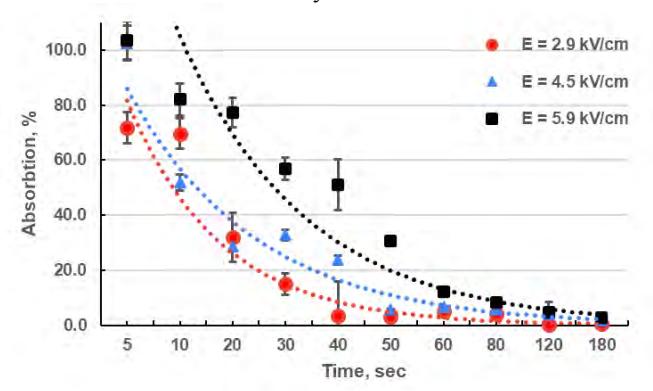
It was shown that quantitative TPP+ uptake by yeasts can be measured using our constructed selective electrode. Recovery dependance on electric field strength was observed (Fig. 1), stronger PEF application caused higher TPP+ absorbtion. Further experimentation of various mutant yeast strains with focus on cell wall components influence on TPP+ absorbtion will be evaluated. With future studies we plan to evaluate yeasts cell wall sturcture influence on electroporation kinetics.