
We report a systematic investigation on the Silver-Aluminium (Ag-Al) mixed films properties and stability to radiation. Protected mixed metallic films were manufactured by magnetron sputtering. Deposited AgAl layer Al concentration was from 0 to 10 percent, maintaining constant layer thickness of 150 nm. Detailed investigation of proton radiation effect on silver-aluminum alloy films is conducted to understand how different aluminum concentrations affect film durability and performance in space applications.
Reflectance spectra were measured in 320 nm – 1300 nm wavelength range with the Photon RT spectrophotometer. Surface topography was measured using a Dimension Edge atomic force microscope (AFM) (Bruker) in tapping mode, over a 20 μm × 20 μm scan area. The AFM probe was an Al and diamond-like carbon (DLC) coated Si probe. Surface roughness evaluation was calculated using AFM measurement data.
Deposited samples reflectance spectra was measured at 8 degrees angle of reflectance. Decrease of reflectance is observed with increase of aluminum doping, likely due to influence of increased electron-to-atom ratio which red-shifts reflectance spectra due to interband transitions [1]. Generation of intermetallic phase of Ag3Al at higher Al doping values is another likely reason for reflectance decrease [2]
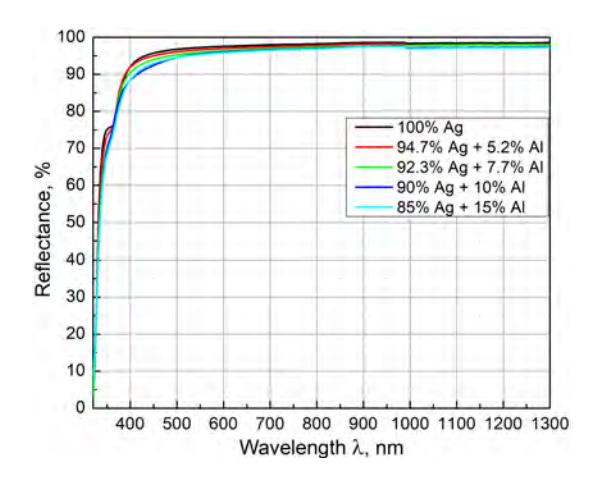
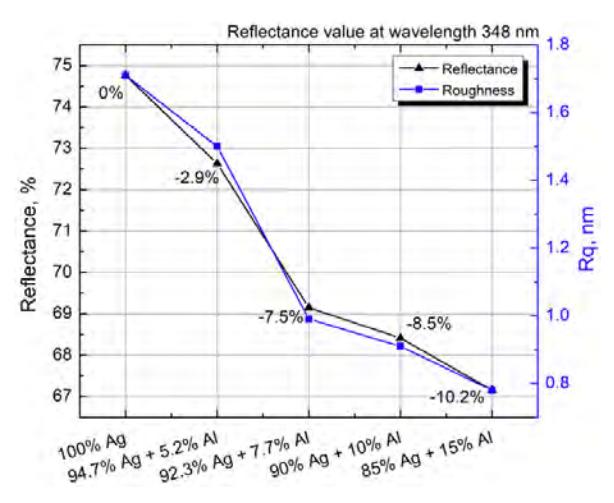
Surface roughness decrease with the increasing Al doping is associated to property of aluminum grow which tends to be denser structure with smaller particles than Ag. This dense structure growth might be associated with lower Al diffusion rate, because metals with smaller diffusion rate exhibits higher nuclei density and smaller particle size [3]. Observed reflectance decrease in UV region is sharper compared to the VIS region (Fig. 1.)
From further radiation analysis it is observed AgAl films provide greater resistance to proton radiation, what makes such films favourable choice for space applications.