Photonic crystal fibers (PCFs) are a special type of optical fibers with a unique periodic microstructure area, consisting of air holes running along the entire length of the PCF. Such structure allows to enhance some of the fiber's main optical characteristics and most importantly: nonlinear response [1-2]. Material nonlinear response will determine the efficiency of nonlinear effects caused by third order nonlinear optical susceptibility $ \chi^{(3)} $, which can be evaluated by using a parameter called nonlinear refractive index $ n_{2} $. The latter parameter is mainly affiliated with the optical Kerr effect, which can be used to describe nonlinear processes such as self-phase modulation (SPM), cross-phase modulation (XPM), four-wave mixing (FWM) and even stimulated Raman scattering. Nonlinear processes appearing in PCF can be qualitatively evaluated only if material's nonlinear refractive index and its dependency on pump wavelengths, i.e., $ n_{2} $ dispersion, in known [3-5]. Several traditional nonlinear refractive index measurement techniques already exist, although, due to the waveguiding effect, they are not applicable to fibers. Therefore, for fibers, methods based on nonlinear processes are used, but usually they are suited to measure $ n_{2} $ only for wavelengths close to the zero dispersion wavelength (ZDW) [6-7].
In this work we present a novel PCF nonlinear refractive index measurement method which works in a broad spectral range. The method combines a measurement of spectrally broadened pulse spectrum (due to self-phase modulation) dependency on pump pulse power at different pump wavelengths, which are obtained by using tunable frequency femtosecond pulse oscillator, together with theoretical modeling. The result (PCF nonlinear refractive index dispersion) is obtained when numerical simulation and experiment results are in good agreement. Tunable frequency pulses were obtained by constructing synchronously pumped optical parametric oscillator (644 nm - 1030 nm), which was pumped with amplified pulses, generated from Yb:KGW laser oscillator operating at 76 MHz repetition rate.
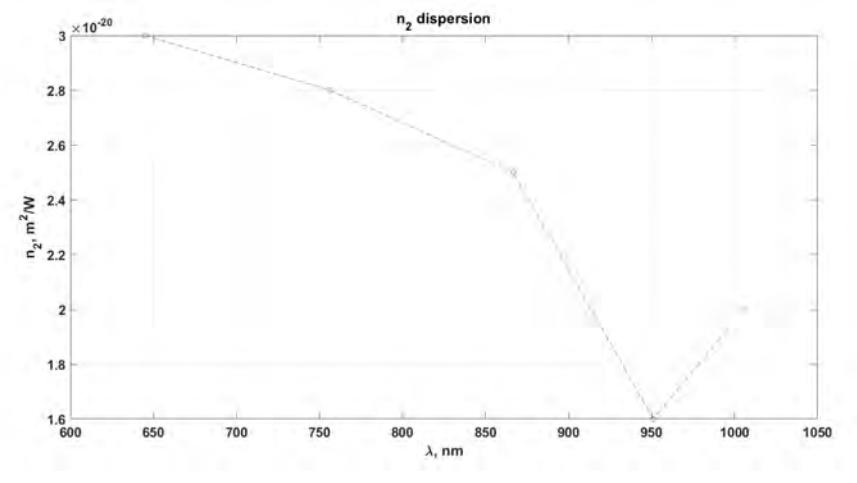
The obtained photonic crystal fiber's nonlinear refractive index at various pump pulse wavelengths is depicted in Fig. 1: $ n_{2} = 3 \cdot 10^{-20} \text{ m}^{2}/\text{W} $ (646 nm); $ n_{2} = 2.8 \cdot 10^{-20} \text{ m}^{2}/\text{W} $ (756 nm); $ n_{2} = 2.5 \cdot 10^{-20} \text{ m}^{2}/\text{W} $ (866 nm); $ n_{2} = 1.6 \cdot 10^{-20} \text{ m}^{2}/\text{W} $ (955 nm); $ n_{2} = 2 \cdot 10^{-20} \text{ m}^{2}/\text{W} $ (1006 nm). From obtained results a significant dispersion of nonlinear refractive index can be observed. We also investigated pulse spectral broadening in the PCF: theoretical modeling enabled to estimate not only PCF nonlinear refractive index dispersion, but also pulse spectrum broadening dynamics. Using tunable frequency femtosecond pulses, it was confirmed, that the pulse broadening in normal dispersion regime is mainly influenced by nonlinear effect, known as self-phase modulation and also PCF's dispersion value.