
The utilization of Multi-Photon Lithography (MPL) as a fabrication technique for three-dimensional (3D) micro-optics with free-form shapes has become increasingly prevalent [1]. Its capability to produce intricate and complex structures with high precision and accuracy makes it a suitable option for various applications, including optical communication, sensing, and bio-medical imaging. To further enhance the properties of MPL-fabricated elements, calcination as a post-treatment method has been shown to produce purely inorganic structures [2]. These inorganic structures possess advantageous characteristics for optical applications, such as high thermal and mechanical stability, low absorption losses, and, as demonstrated in this study, exceptional potential for the creation of optically active inorganic structures doped with rare-earth elements [3, 4].
This study describes the fabrication of a notched Whispering Gallery Mode Resonator (WGMR) utilizing MPL and calcination at 1100 °C post-treatment on SZ2080TM organic-inorganic photo-resist doped with Eu3+ elements. The combination of MPL and calcination techniques provides control over optical and material properties, resulting in the creation of a non-trivial geometry active resonator. The device design was optimized for high fluorescence emission directionality using a Finite Difference Time Domain numerical model, resulting in an elliptical-shaped WGMR with a sub-wavelength size notch serving as a scattering point (Fig. 1 a)). The fabricated devices were tested using a UV-VIS spectrophotometer system with varying pump power and a central wavelength of 325 nm CW laser. A distinct emission peak at 587 nm was observed, coinciding with the resonator's TM57,1 mode, and with a measured quality factor Q higher than 1000 (Fig. 1 b)).
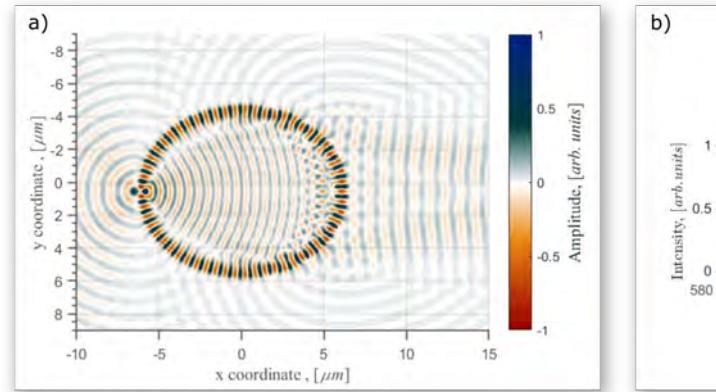
The results of our initial experiments demonstrate the feasibility of utilizing calcinated hybrid organic-inorganic photoresist SZ2080TM as a suitable host matrix for active lanthanide group element fluorescence. This advanced additive manufacturing technique presents a promising platform for a broad spectrum of micro-photonics applications, particularly in cases requiring complex geometries or multi-element systems.