
The use of silver nanoparticles (AgNPs) has been proposed as a novel strategy for combating bacterial and viral strains with high resistance. AgNPs, which are well-known nanoparticles, have been widely utilized in the identification, treatment, and neutralization of viral infections [1]. For particles with at least two dimensions under 100 nm, it is crucial to examine their acceptable toxicity. Silver nanoparticles have recently garnered significant attention as potential antibacterial agents among nanoparticles [2]. This has resulted in silver-based biocides becoming increasingly prevalent. The synthesis of AgNPs can be achieved through a variety of methods, including physical, chemical, and biological approaches.
In this work, a UV-mediated photochemical synthesis method was employed to prepare coatings on quartz glass substrates using the doctor blade coating technique. Silver nitrate (AgNO3) was utilized as the precursor, and the solution of AgNO3 was incorporated into a polyvinyl butyral (PVB) matrix. The experiments were conducted under ambient temperature and pressure conditions using a dual-wavelength UV-Vis source (Desaga Heidelberg 220V, 75W) with wavelengths of 254 nm (1.64 mW/cm2 intensity) and 366 nm (0.80 mW/cm2 intensity). The structural properties of the coatings were characterized using various techniques such as atomic force microscopy (AFM), UV-Vis's spectroscopy, X-ray diffractometry (XRD), and water contact angle (WCA) measurements.
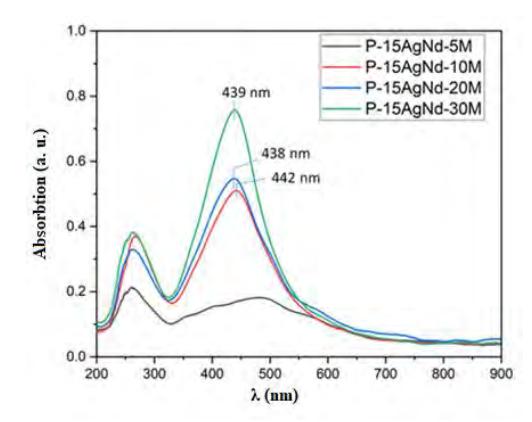
The AgNPs-PVB nanocomposite material was characterized through various techniques. The results of these analyses revealed a well-ordered distribution of AgNPs within the polymer matrix of PVB. As the duration of UV irradiation exposure increased, a decrease in the diameter of the AgNPs from 120 to 20 nm was observed, along with a slight change in elasticity (7.6±0.6 N/m) and significant variations in adhesion force. These findings demonstrate that the size and adhesion strength of the NPs can be controlled through adjustments in the UV exposure time. The absorption spectra of the AgNPs-PVB nanocomposite films were recorded and analysed in the wavelength range of 200-900 nm after removal of the PVB polymer on the glass substrate. The UV-Vis spectra showed maxima of Ag peaks at the wavelengths of 438 nm, 439 nm, 442 nm, and 499 nm, indicating the formation of AgNPs with different geometric dimensions in the PVB polymer network. As the exposure time increased from 5 to 30 minutes, the size of the AgNPs decreased. Additionally, the wetting angle of the formed PVB coating on the glass was found to be low at 87.1°. As the duration of exposure to UV irradiation increased and the diameter of AgNPs decreased, the wetting angles of the inserted AgNPs into the PVB polymer network also decreased. Further research could focus on investigating the antiviral properties of the AgNPs-PVB coating and its potential applications in healthcare and food packaging.