
Tethered bilayer lipid membranes (tBLMs) are widely used as a convenient biological membrane-mimicking platform to study biochemical and biophysical processes with great potential for biomedical applications [1]. Submembrane water reservoir plays an important role in tBLMS functionality and is affected by the composition and structure of anchoring self-assembled monolayers (SAMs). However, detailed molecular level information on the structure and formation in a solution of mixed SAMs used for tBLM construction is rather scarce [2]. That is largely due to the limited availability of techniques that are able to directly probe electrode/solution interface at the molecular level.
In this work, we used surface-enhanced infrared absorption spectroscopy (SEIRAS) for direct in-situ observation of two processes at gold-solution interface: mixed SAM monolayer formation from thiols (WC14 (20-(tetradecyloxy)-3,6,9,12,15,18,22-heptaoxahexatriacontane-1-thiol) and ME (2-mercaptoethanol)) followed by the development of lipid bilayer from multilamellar vesicles of deuterated phospholipid and cholesterol (DPPC-d62/cholesterol-d7).
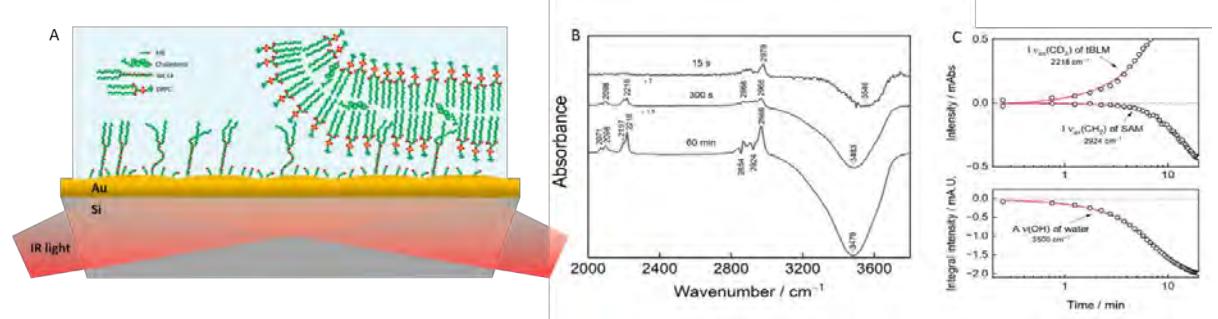
Our study revealed that ethyleneglycol chains of long-chain thiol in SAM are in the predominant amorphous state, while alkyl chains are in the disordered state providing the required flexibility for the formation of the bilayer. The bilayer is formed in two stages (Fig 1A), first through lipid adsorption and simultaneous removal of water from the surface, and second through the lipid membrane inner layer insertion/interaction with SAM, resulting in structural changes of monolayer alkyl chains. We show, that around 60 minutes are required for the full development of the lipid bilayer formed from vesicles composed of a mixture of partially deuterated compounds DPPC-d62/cholesterol-d7.