
Supercontinuum (SC) is an effect that results from femtosecond filamentation, which occurs during the nonlinear propagation of an intense ultrashort laser pulse in a transparent material [1]. Sapphire and YAG are the most reliable and commonly used nonlinear materials for SC generation in the visible and near-infrared spectral range for ultrafast applications [2, 3]. However, the performance can be limited at high laser pulse repetition rates, since the multiple pulse exposure can lead to optical degradation. Their performance can also be limited by the compromise in the pump energy at high laser pulse repetition rates (up to a few MHz). This is particularly crucial in SC-seeded high repetition-rate noncollinear optical parametric amplifiers [4] and optical parametric chirped-pulse amplification systems [5].
These limitations call for nonlinear materials with lower SC generation thresholds. Narrow-bandgap crystals, such as KGW, exhibit high nonlinearity (KGW: n2 = 11 × 10-16 cm2/W [1]), which results in very low critical power for self-focusing and hence allows SC generation with very small input pulse energies (sub-100 nJ). However, there are only a few studies of SC generation in KGW in general, and no investigations, to our knowledge, at high repetition rates.
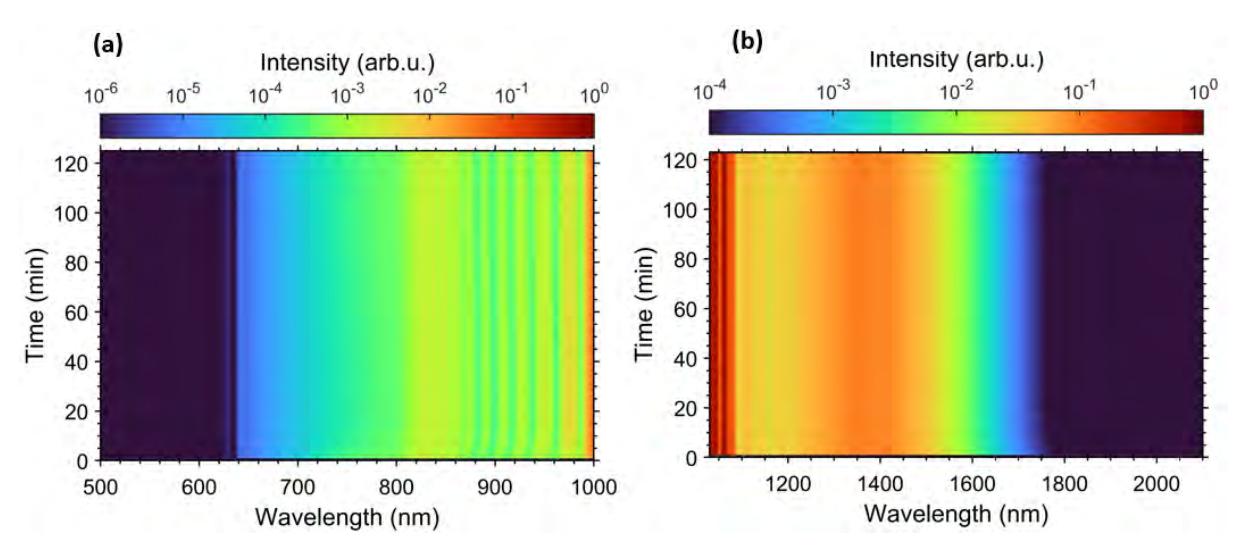
In this study, the SC generation in sapphire, YAG, and KGW crystals (6 mm length) was investigated with femtosecond Yb:KGW lasers, which deliver 200 fs, 1030 nm pulses at 200 kHz and 2 MHz repetition rate. The SC was generated at lower energies in KGW compared to sapphire and YAG. The largest spectral broadening into the IR region was also obtained in the KGW crystal (up to ~ 1.8μm). The nonlinear transmission was also investigated in the three crystals. For sapphire, the absorbed energy at input energy of 0.75 μJ was 0.06 μJ, for YAG the absorbed energy was 0.01 μJ at 0.37 μJ input energy, and for KGW, it was 0.009 μJ at 0.14 μJ input energy. YAG and KGW have the lowest energy absorption, and consequently potentially less heat accumulation, making them suitable for SC generation at very high repetition rates. KGW showed a lower threshold energy for SC generation, making it more suitable for SC generation at very high repetition rates. Therefore, the time evolution of the KGW crystal at 2 MHz was studied and further proved the potential of the crystal in ultrafast applications. As illustrated in Figure 1, the crystal showed a stable performance for 2h with no optical degradation, which opens new possibilities for the use of KGW in new laser systems operating at repetition rates in the MHz range.