The development of telecommunication systems requires fast, wireless signal transmission. Terahertz (THz) radiation frequencies allow to increase data transfer ratio compared to the ones used nowadays by end-users of telecommunication Wi-Fi system [1]. One of the ideas to achieve it, is an application of passive optical components for multiplexing and/or demultiplexing of radiation within the THz telecommunication system. This work presents components realizing the latter functionality – single-input multiple-output (SIMO) structures realized by a single diffractive optical element (DOE) redirecting the THz beam at a different angles for different frequencies and focusing it on a detector. Designed and manufactured SIMO structures might find application in spatial frequency-division demultiplexing in THz telecommunication systems.
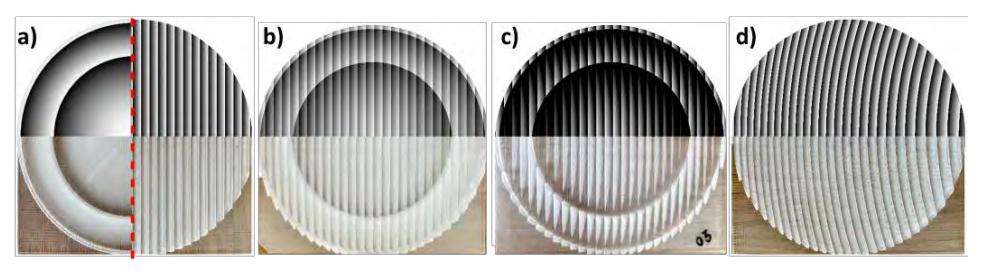
DOEs allow for the desired beam shaping and manipulation according to the designer's idea [2]. Proposed SIMO structures are the combination of two different DOEs: diffraction grating and kinoform lens. The kinoform lens part corresponds to focusing of the incoming radiation into single focal spot, guaranteeing high diffraction efficiency of up to 100%. The second component – diffraction grating, allows for the spatial separation of beams of different THz frequencies previously traveling along a single optical channel. Images of gray-scale phase delay maps of designed elements are illustrated in Fig. 1 – top row. Elements were numerically simulated and then, based on these results, manufactured, which is presented in Fig. 1 – bottom row.
After numerical simulation tests, four different variants of SIMO (1-4) structures were manufactured using fused deposition modeling (FDM) 3D printing technology. All four lenses were manufactured from cyclic olefin copolymer (COC) material previously examined with THz time-domain spectroscopy [3] due to desired optical properties in the THz radiation range of that material (refractive index equal to about 1.5 and low absorption coefficient in the whole examined spectral range).
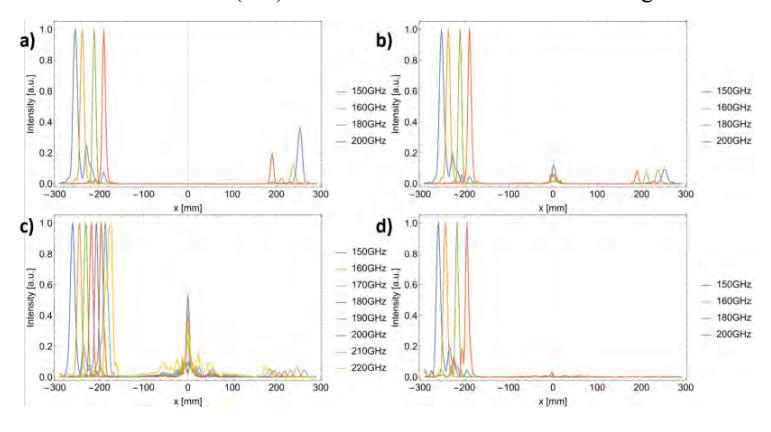
Fabricated lenses were verified experimentally and according to previously obtained simulation results, all four SIMO structures' performance corresponded to theoretical expectations. SIMO structures correctly separated spatially different THz frequencies and focused them into the -1st diffraction order concerning the designed focal length of 700 mm. Experimental results are presented in Fig. 2.