
Humanity cannot abandon economic activity, but the aim is to contribute to its lower negative impact on the environment. The current direction of development is the green course, and its main goal is to create a sustainable, modern economy without harming the environment. In order to avoid the negative effects of intensive farming, various options for sustainable agriculture are often offered, such as partially replacing synthetic fertilizers, replacing chemical plant protection measures with biological ones. Due to the growing world population, the agricultural industry is challenged to produce the required amount of food. This is not possible without the use of fertilizers [1]. The use of chemical fertilizers is one of the most common ways of developing intensive agriculture nowadays [2, 3]. However, the continuous long-term use of chemical fertilizers causes negative effects on the environment, such as soil degradation, pollution of bodies of water. In the fertilizer market, new products, which focus on the processes occurring naturally in the plant and the circular economy, are now appearing next to traditional fertilizers more frequently. Residues from other agricultural branches can be used as an alternative raw material to produce fertilizers. The current trends in insect breeding, which are gaining wider applicability and legalization for use in the food industry, also create prerequisites for the development of possibilities for processing waste products [4].
Under laboratory conditions, studies of frass were carried out (Fig. 1) by the company UAB "Divaks", concerning the suitability for fertilizer production, the chemical composition of frass and the composition of their extracts. Nitrogen, phosphorus and potassium content and properties of samples were determined by using standard techniques [5].
Table 1 shows the concentrations of the major nutrients identified in the Frass samples.
| Example | N, % | P2O5, % | K2O, % |
|---|---|---|---|
| DF1 | 20.22 | 1.10 | 2.69 |
| DF2 | 15.89 | 1.53 | 2.77 |
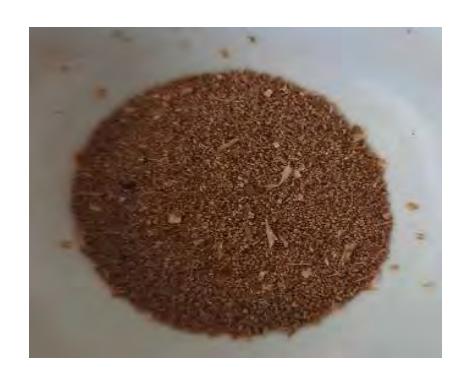
The physical properties of two different frass samples were tested. The pH of the 10% solution of the first sample (DF1) is 5.85, the moisture content is 7.41%, the bulk density is 524.89 kg/m3, the 0.2–0.5 mm fraction is the major part - 93.36%. The pH of the 10% solution of the second sample (DF2) is 5.45, the moisture content is 8.76%, the bulk density is 393.81 kg/m3, the 0.2-0.5 mm fraction is the major part – 95.75%.
Seeing that frass contains a large amount of organic matter, carbon concentration studies were conducted. The possibility of extracting the plant nutrients contained in frass using different solvents was also investigated. The samples of Frass aqueous solutions and extracts in acidic and alkaline media were prepared under different conditions and using different experimental durations. The concentration of the main nutrients (N, P, K) and carbon were determined in the extracts. The concentration of carbon in the extracts depends mostly on the duration of the extraction. It was also found that the carbon concentrations in the potassium hydroxide solutions are close to the carbon levels present in the original samples. Extracts, obtained by using potassium hydroxide, can be used as a fertilizer component to increase the carbon content of the soil.
The use of insects for human and animal foods and fertilizer is expected to continue to grow as it has the potential to help reduce the amount of waste, increase food reserves and yields.