
Periodically arranged micro-particles and their structures are found in many applications. Such use is based on a plasmonic effect resulting from light interaction with metal structures. Plasmonics holds huge interest as it is considered a promising effect in terms of utilization in the field of new optical devices, where it is based on surface lattice resonances (SLRs). SLRs are collective charge oscillations coupled to an external electromagnetic field that propagates between metal and a dielectric interface. However, more investigations must be done to improve quality and expand the field of use.
In this work, the SLRs effect is achieved with diffraction phenomena [1], where arranged microparticles of gold act as diffractive grating, demonstrating plasmonic resonances for incidence light. When a plasmon is successfully excited by a photon, the light particle is absorbed, which is reflected in the reflection graph. Such use of a diffraction grating is conditioned by SLR theory, as direct incident light on a flat metal surface can not excite a plasmon due to a momentum mismatch, as a free-space photon has less momentum (wavevector is smaller) than a localized plasmon.
In this study, periodic arrays of microbumps formation were produced on a thin 50 nm gold layer with different titanium adhesion layer thickness (from 0 to 10 nm), using laser direct writing technique (LDW) and forming gold microbumps by a 0.4 nJ single laser pulse. Formed structures were analyzed with a spectrophotometer and a scanning electron microscope (SEM).
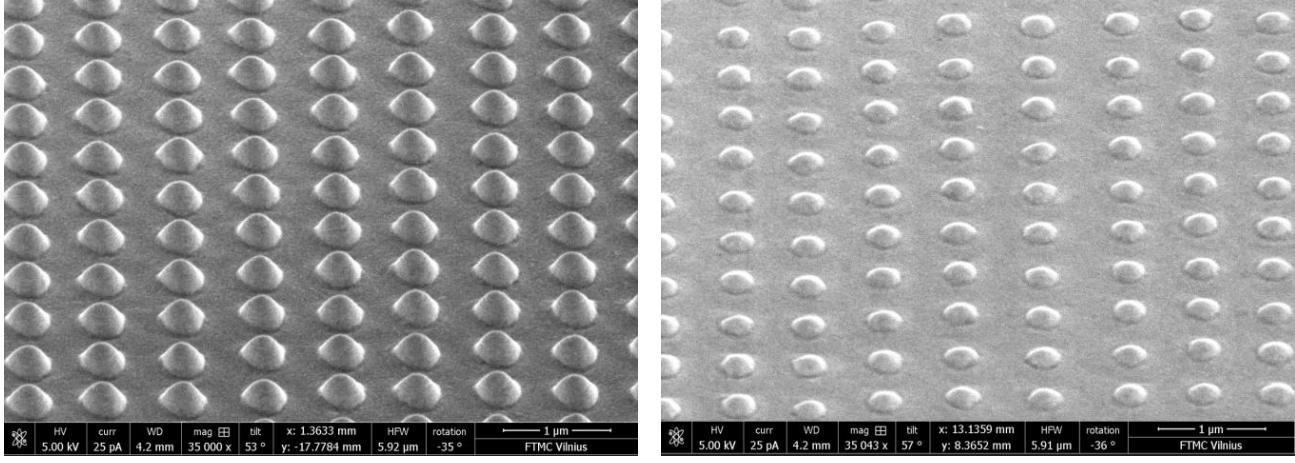
The results demonstrate that SLRs besides the main dependencies on the period of the fabricated arrays, light polarization, incident angle of light, and the sample orientation, also show a strong dependency on the adhesion layer, as with an additional titanium layer between the substrate and gold film, better results were achieved. Such experimental results were confirmed by a "basic" tape test, where adhesion was tested by a peeling/removing test and evaluating it by an adhesion rating scale.
The influence of the adhesion layer was compared by measuring spectrophotometer graphs by evaluating the parameters of peaks: depth, full width at half maximum (FWHM), Q factor, and MQ factor.