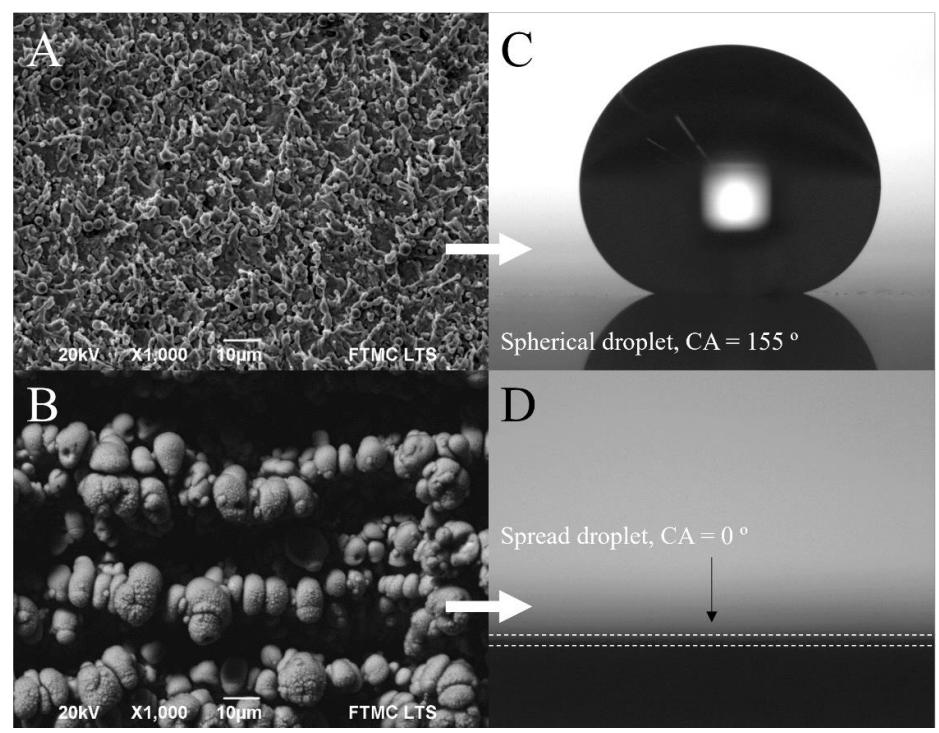
Laser processing is an acknowledged technique for the modification of materials' surface properties and therefore has the potential for various applications. The creation of functional surfaces that exhibit various wetting behaviour by laser texturing has been demonstrated numerous times [1]. This work focuses on the control of the wetting properties of copper.
This work aimed to create copper surfaces with different wetting properties (from highly hydrophilic to superhydrophobic). A nanosecond laser was used to process copper samples. The wetting states were determined from static contact angle (CA) measurements, which were performed multiple times during an extended period to track the changes in surface properties over time. A scanning electron microscope (SEM) and 3D optical profiler were used to visualise the surface structures that were formed during laser treatment.
Highly hydrophilic and superhydrophobic surfaces, as well as some states in between, were achieved with different laser texturing parameters (Fig. 1). The CA increased over a longer period of time for almost all different textures regardless of their initial wetting state directly after processing. The influence of surface morphologies on the wetting state was considered and laser processing parameters for the creation of hydrophilic and hydrophobic surfaces were determined.